You upload two videos in the same week. Both reach about 10,000 views. One earns $12 and the other earns $90, and you can’t work out why. How much does YouTube pay per video, and why do two videos with identical views land so far apart?
The quick answer: there’s no fixed price per video. A video pays roughly views ÷ 1,000 × RPM, where RPM is what you keep per 1,000 views. For long-form US videos in our model, that’s about $0.44 to $37 per 1,000 views, depending on niche and length. The lowest end is a 2-dollar-CPM niche such as gaming or music under 8 minutes. The highest is finance at 40 minutes or more. A US tech video of 8 minutes or longer with 10,000 views earns roughly $26 to $109.
This article focuses on one video at a time: its length, its niche, its audience and its age. For the per-view rate on its own, see how much money you get per view on YouTube. For a whole month of views, see how much YouTube pays per month.
The simple formula for one video
Video earnings = (views ÷ 1,000) × RPM
RPM stands for revenue per mille, which is what you keep per 1,000 views. YouTube defines it as your revenue after YouTube’s share, per 1,000 views (YouTube Help). The calculator estimates it from four inputs: the niche’s ad rate, your audience’s country, the share of views that show an ad, and your video’s length.
Not every view shows an ad. YouTube says ads don’t run on every view, for reasons including ad blockers, content that isn’t monetizable, and unsold ad inventory. That’s why the model assumes only 40% to 60% of views are monetized. Your 55% creator share then applies to whatever those monetized views earn.
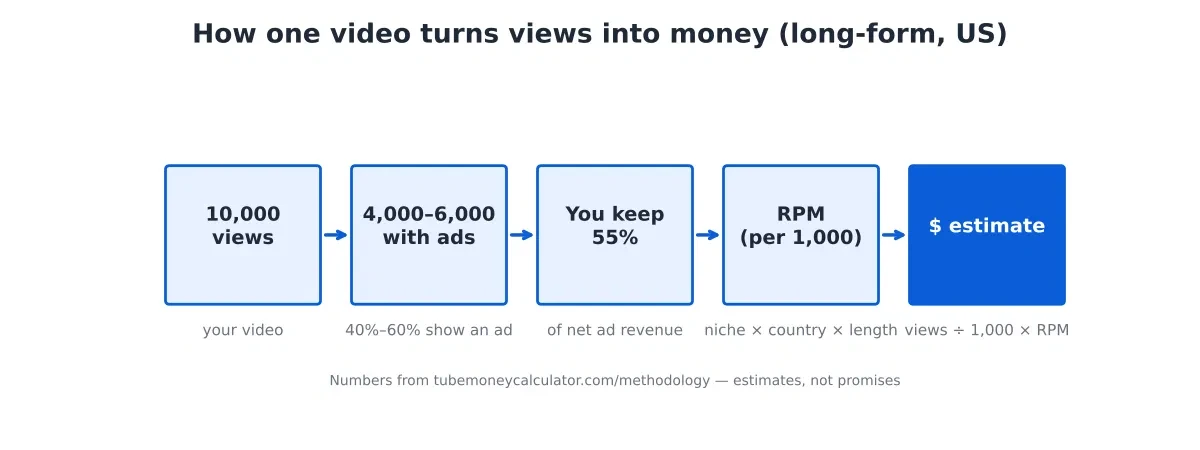
Then, the video’s length adds a boost. Videos that are 8 minutes or longer can carry mid-roll ads (YouTube Help), so the calculator multiplies RPM by 1.5 at 8 minutes, rising to 2.5 at 40 minutes. Under 8 minutes, there’s no boost.
What 10,000 views pays on six different videos
Here are the calculator’s ranges for the same 10,000 views, each using its own niche, country and length:
| Video type | RPM (low to high) | 10,000 views, low to high |
|---|---|---|
| US finance, 8+ min | $4.95 – $22.28 | $49.50 – $222.75 |
| US tech, 8+ min | $2.64 – $10.89 | $26.40 – $108.90 |
| US cooking, 8+ min | $1.32 – $5.94 | $13.20 – $59.40 |
| US cooking, under 8 min | $0.88 – $3.96 | $8.80 – $39.60 |
| Canada gaming, 8+ min | $0.56 – $3.37 | $5.61 – $33.66 |
| US Shorts | $0.03 – $0.15 | $0.30 – $1.50 |
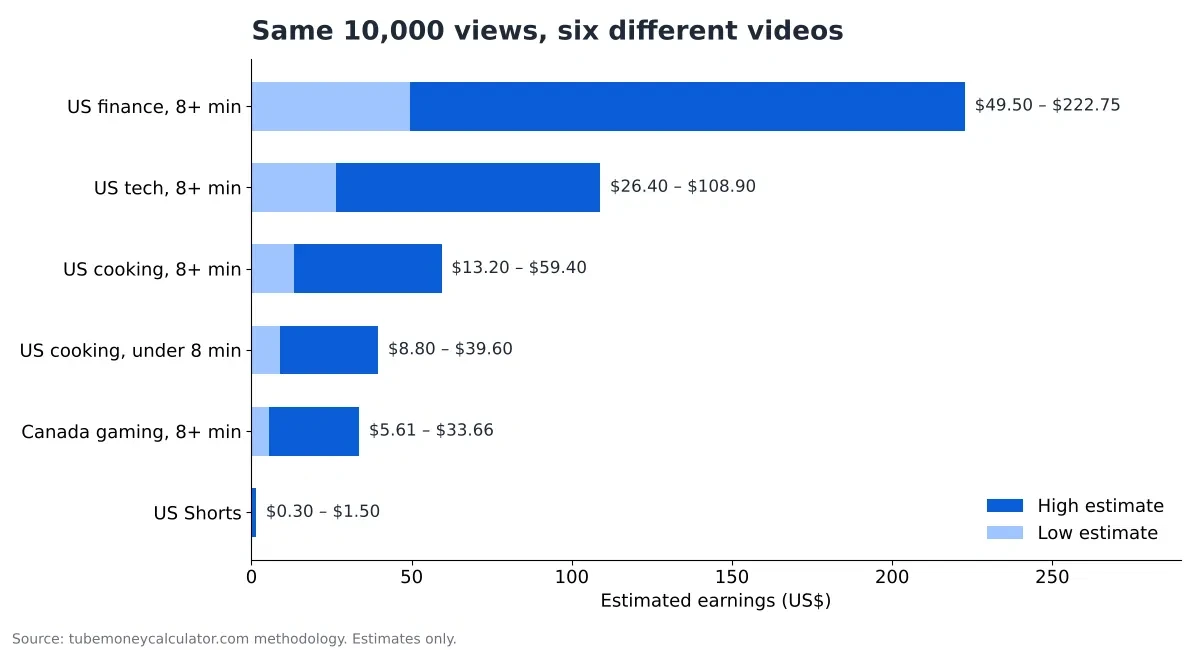
The top and bottom rows differ by a factor of about 150 at the high end. That’s the single most useful thing to take from this table: the type of video matters more than the view count.
Why one video earns more than another
Niche. Advertisers pay more to reach some audiences than others. Our model uses a finance CPM of $15 to $45, business and marketing of $12 to $35, and technology of $8 to $22. Gaming, music, comedy and kids’ content sit lower, at roughly $2 to $8. Same views, very different rate.
Audience country. The US is the reference point at 1.00. Canada is counted at 0.85, the UK at 0.88 and Australia at 0.90. Viewers in lower-paying markets reduce the rate further, and the calculator’s country list runs well below 1.00 for many places.
Length. This is where small creators most often go wrong. A video of 8 minutes or longer can carry mid-roll ads and gets a 1.5× boost. But padding a video to reach 8 minutes doesn’t help if viewers leave. Make it as long as the topic needs, and let the boost follow.
Shorts are paid differently. Shorts draw from a shared pool, and creators keep 45% of their allocated share (YouTube Help). In our model, a US Short earns $0.03 to $0.15 per 1,000 views, a small fraction of a long video. Our Shorts pay article explains the mechanics.
The month the views happen. Advertising prices follow the calendar. Our model uses a seasonal factor from 0.75× in January to 1.35× in December, so the same video can earn very differently depending on when it’s watched. Our guide to why earnings drop in January covers the pattern.
Worked example 1: a 50,000-view cooking video in the US
Imagine one cooking video with 50,000 views, US audience. Here’s what the same views would earn in three formats.
As an 8+ minute video (RPM $1.32 to $5.94, using the 1.5× boost):
- 50 × $1.32 = $66.00
- 50 × $5.94 = $297.00
As an under-8-minute video (RPM $0.88 to $3.96, no boost):
- 50 × $0.88 = $44.00
- 50 × $3.96 = $198.00
As a Short (RPM $0.03 to $0.15):
- 50 × $0.03 = $1.50
- 50 × $0.15 = $7.50
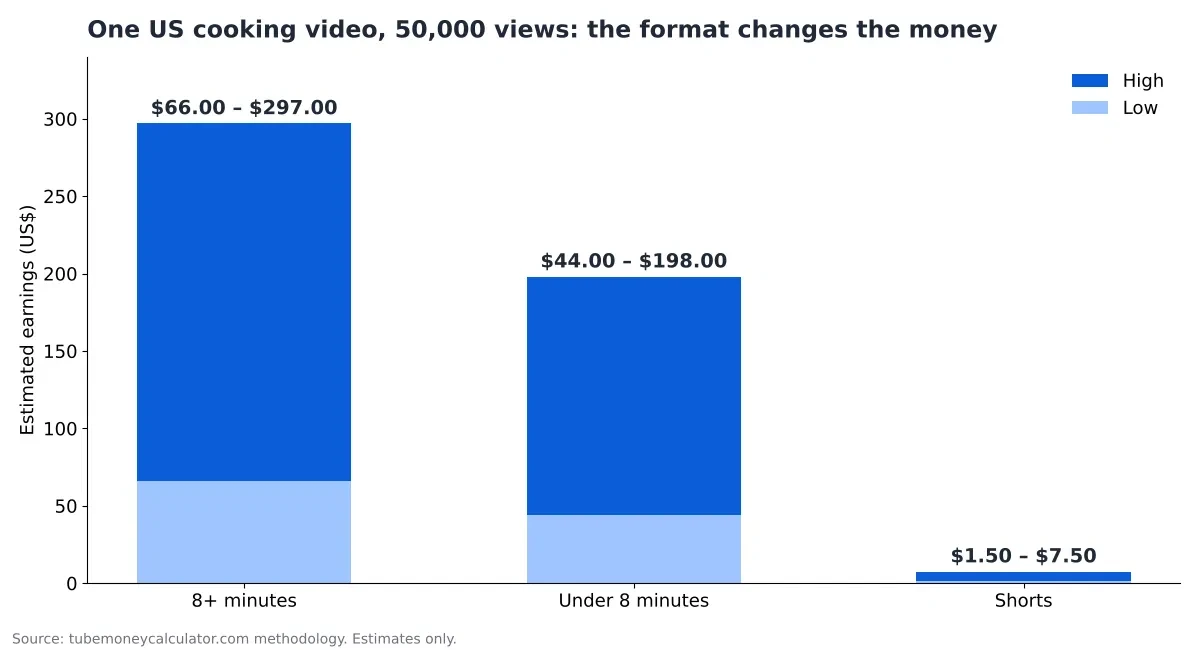
The 8-minute version beats the Short by about 40 times at the low end. Same audience, same topic, same views. The format is the decision.
Worked example 2: a 100,000-view gaming video in Canada
A Canadian gaming video, 8 minutes or longer, with 100,000 views. Gaming CPM is $2 to $8, Canada is 0.85×, and the 8-minute boost is 1.5×:
- Low RPM: $2 × 0.85 × 40% × 55% × 1.5 = $0.561 per 1,000 views
- High RPM: $8 × 0.85 × 60% × 55% × 1.5 = $3.366 per 1,000 views
- Low: 100 × $0.561 = $56.10
- High: 100 × $3.366 = $336.60
So the video earns about $56 to $337. That’s a meaningful range, and the gap between the ends comes from the advertisers’ bids and the share of views that show ads, both of which change over time.
A video keeps earning after week one
A video doesn’t stop earning after its first burst of views. Views keep arriving from search and suggestions, and each one adds to the total. Here’s a made-up example to show the pattern. The numbers are illustrative, not real data.
Say a US cooking video, 8 minutes or longer, gets 8,000 views in its first month, then 1,000 views a month for the next 11 months. That’s 19,000 views in total.
- Month 1: 8 × $1.32 = $10.56 to 8 × $5.94 = $47.52
- Months 2 to 12: 11 months at 1 × $1.32 to 1 × $5.94, which is $14.52 to $65.34
- Year one total: $25.08 to $112.86
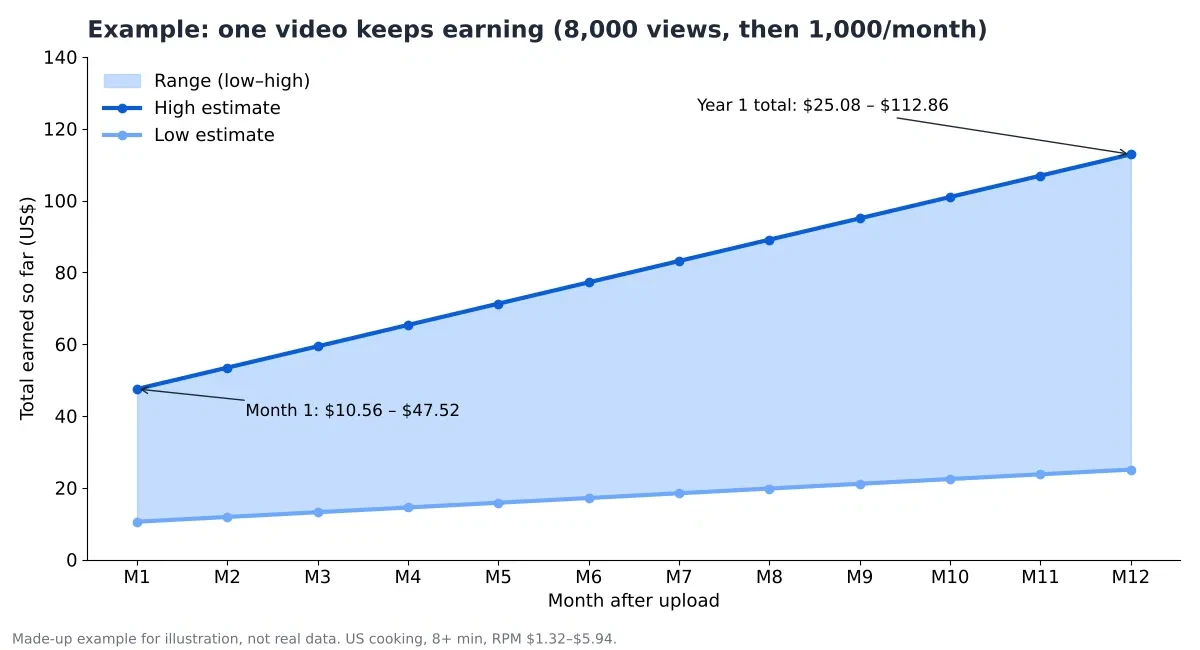
The first month makes the most, but the tail is real. That’s why a library of searchable videos can out-earn a single hit over time.
Season also changes the same video. Take the US tech video with 10,000 views from earlier, which earns $26.40 to $108.90 at normal prices. In December, at 1.35×, it earns about $35.64 to $147.02. In January, at 0.75×, it earns about $19.80 to $81.68. Same video, same views, roughly 44% less money in January.
How many views does one video need to make $100?
Reverse the formula: views needed = $100 ÷ RPM × 1,000. These are the low and high ends, for one video:
| Video type | Views for $100 (high RPM) | Views for $100 (low RPM) |
|---|---|---|
| US finance, 8+ min | about 4,500 | about 20,200 |
| US tech, 8+ min | about 9,200 | about 37,900 |
| US cooking, 8+ min | about 16,800 | about 75,800 |
| Canada gaming, 8+ min | about 29,700 | about 178,300 |
| US Shorts | about 666,700 | about 3,333,300 |
Read the table as: a finance video of 8 minutes or longer gets to $100 with somewhere between roughly 4,500 and 20,200 views. A Short needs somewhere between 667,000 and 3.3 million views to do the same. That’s the gap a creator is really choosing between.
How to see what one of your videos earned
YouTube’s official route, from the Check your YouTube revenue Help page:
- Sign in to YouTube Studio and select Content in the left menu.
- Hover over the video and click its Analytics icon.
- Open the Revenue tab for that video. It shows the estimated revenue and RPM for the period you’ve chosen.
Two things to know. Revenue takes about two days to appear, and the figure is an estimate. YouTube makes adjustments for invalid traffic, copyright claims and certain ad campaign types, and the finalized amount is added to your AdSense for YouTube balance between the 7th and 12th of the following month. For the full timing, see how to see your YouTube earnings in Studio.
How to estimate any video in 60 seconds
- Open the TubeMoneyCalculator and go to the Views to Money tab.
- Enter the video’s views for the period you care about.
- Pick the niche and the audience country.
- Pick the video length: under 8 minutes or 8 minutes and longer.
- Read the low and high estimates. If you know your real RPM from Studio, use the “Know your real RPM” box to compare it with the range.
Treat the output as a range, not a promise.
Before you count on per-video money
Ad revenue from a video only arrives once your channel is in the YouTube Partner Program. Today, that means 1,000 subscribers plus 4,000 qualified watch hours in the last 12 months, or 10 million qualified Shorts views in the last 90 days (YouTube Help).
From February 1, 2027, new applicants need 1,000 subscribers plus 8,000 qualified watch hours in the last 365 days, or 20 million qualified Shorts views in the last 90 days. Shorts revenue sharing will also need 10 million qualified Shorts views in the last 90 days. Existing partners aren’t affected by the new entry bar. See YouTube’s official announcement and our 2027 changes guide.
FAQ
How much does a 10-minute YouTube video make?
A 10-minute video is 8 minutes or longer, so it gets the mid-roll boost. For a US tech video with 10,000 views, that’s about $26 to $109. For a US cooking video with the same views, about $13 to $59. The niche and country matter more than the length alone.
Does a video earn money forever?
Yes, as long as it stays public and monetized, and the views keep coming. Earnings from a video usually fall off over time but rarely drop to zero. The illustrative example above shows a video earning in year one from a modest monthly trickle.
Why did my video with more views earn less?
The likely reasons are niche, audience country, video length, the share of views that showed an ad, or the month. A higher view count on a shorter video in a lower-paying niche can still earn less than a smaller count on a longer video in a higher-paying one. Compare RPM rather than views.
Do I get paid per video or per month?
Per month. YouTube pools your earnings from all videos, and pays them out in a monthly payment, as long as your balance is at least $100. See how YouTubers get paid for the full schedule.
Your next step
Pick the video you’re curious about, then run it through the Views to Money tool. Enter its views, niche, country and length, and read the range. Then open the same video in YouTube Studio and compare its real RPM with the estimate. That’s the fastest way to learn what your own audience is worth per video.
All figures here are estimates from our published methodology, not official YouTube rates. Rules and Studio steps checked October 29, 2026. The lifetime example is illustrative, not real data.