A million subscribers sounds like a salary. Then you see one channel with that many people following it making a few hundred dollars a month, and another making more than $13,000 with a similar count. How much do YouTubers make with 1 million subscribers, and why can the answers be so far apart?
The short answer: YouTube doesn’t pay per subscriber. Ad income comes from monthly views, so a 1-million-subscriber channel earns monthly views ÷ 1,000 × RPM. In our examples, four channels with a million subscribers each earn between about $99 and $13,365 a month from ads. A busy US finance channel can pass $22,000 at the high end. The biggest factor is how many views those subscribers bring each month, which is a number you can check in YouTube Studio.
Why 1 million subscribers is not a salary
Subscribers are people who chose to follow you. They don’t set the price of an ad, and they don’t guarantee that anyone watches the next video. Many subscribers watch only sometimes, and many viewers never subscribe. Views are what YouTube counts when it pays out.
The formula:
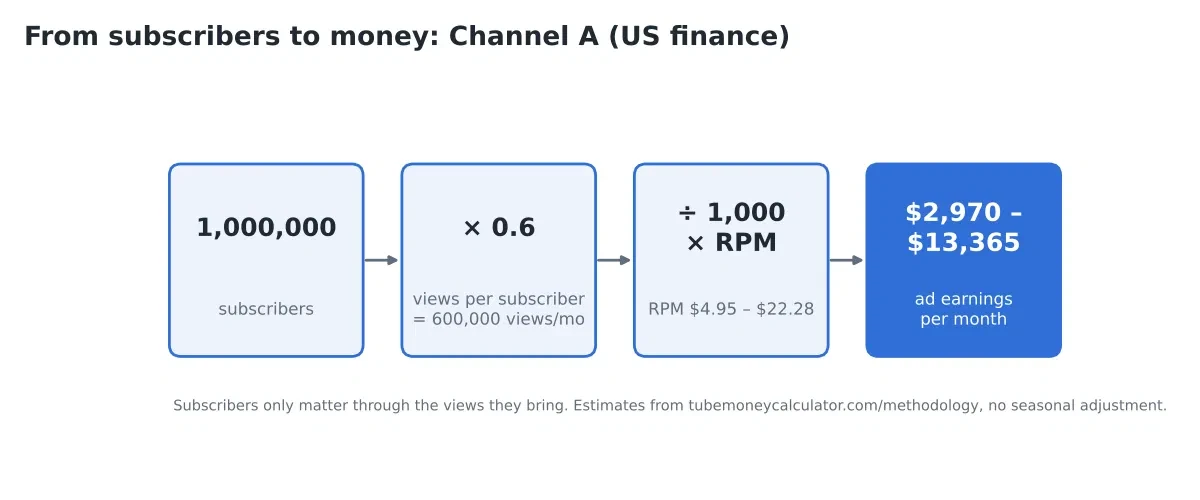
Monthly ad earnings = (monthly views ÷ 1,000) × RPM
RPM is what you keep per 1,000 views. The creator keeps 55% of net revenue from ads on long-form videos (YouTube Help), and 45% of the Shorts revenue allocated to them from the Shorts pool (YouTube Help). RPM then depends on the niche, the viewer’s country, the share of views that show an ad, and whether videos run 8 minutes or longer.
Nothing in that formula is the subscriber count. Subscribers matter only through the views they bring.
The number that matters: views per subscriber
Once you know your monthly views and your subscriber count, you can compare the two. We call the ratio views per subscriber. It’s our term, not a YouTube metric, but it’s the fastest way to tell whether a channel’s audience is active.
Views per subscriber = monthly views ÷ subscribers
To find it, open YouTube Studio, go to Analytics, and note views for the last 28 days. Multiply by about 1.07 to get a 30-day figure. Then divide by your subscriber count.
A ratio of 0.1 means most of your subscribers aren’t watching much. A ratio of 1 or more means your videos are reaching well beyond your subscriber base. The four channels below sit at very different points on this scale.
Four channels, one million subscribers each
These are example channels, not real ones. Each uses the calculator’s methodology and assumes no seasonal adjustment.
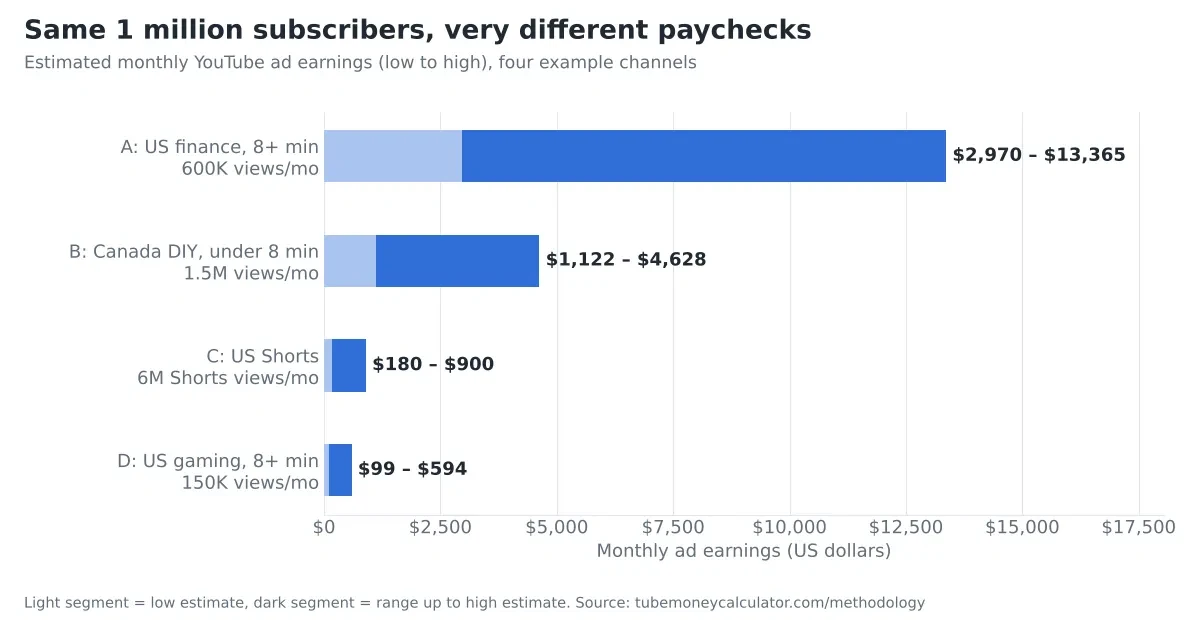
Channel A: US finance, 600,000 views a month
Videos are 8 minutes or longer, the audience is in the US, and the niche is finance.
- Views per subscriber: 600,000 ÷ 1,000,000 = 0.6
- Low RPM: $15 × 1.00 × 40% × 55% × 1.5 = $4.95
- High RPM: $45 × 1.00 × 60% × 55% × 1.5 = $22.28
- Monthly: 600 × $4.95 = $2,970 to 600 × $22.275 = $13,365
Channel B: Canada DIY, 1,500,000 views a month
DIY videos are under 8 minutes, so the mid-roll boost doesn’t apply. The audience is in Canada, which is counted at 0.85×.
- Views per subscriber: 1,500,000 ÷ 1,000,000 = 1.5
- Low RPM: $4 × 0.85 × 40% × 55% = $0.748
- High RPM: $11 × 0.85 × 60% × 55% = $3.0855
- Monthly: 1,500 × $0.748 = $1,122 to 1,500 × $3.0855 = $4,628
Channel C: US Shorts, 6,000,000 Shorts views a month
Shorts pay from a shared pool at $0.03 to $0.15 per 1,000 views in the US.
- Views per subscriber: 6,000,000 ÷ 1,000,000 = 6
- Monthly: 6,000 × $0.03 = $180 to 6,000 × $0.15 = $900
Now the February 1, 2027 rule. Shorts revenue sharing will need 10 million qualified Shorts views in the last 90 days (YouTube Blog). At 6 million a month, this channel reaches about 18 million in 90 days, above the line. But if its Shorts views dropped to 3 million a month, it would reach 9 million in 90 days, below the line. Its Shorts pay would pause at $0 while it stayed in the Partner Program and kept earning from long-form.
Channel D: US gaming, 150,000 views a month, slowing down
Gaming pays less per view, and this channel’s views have fallen off since its peak.
- Views per subscriber: 150,000 ÷ 1,000,000 = 0.15
- Low RPM: $2 × 40% × 55% × 1.5 = $0.66
- High RPM: $8 × 60% × 55% × 1.5 = $3.96
- Monthly: 150 × $0.66 = $99 to 150 × $3.96 = $594
Channel D shows the trap clearly. A million subscribers and a ratio of 0.15 can still mean under $600 a month, because most of the audience has stopped watching.
Quick table: 1 million subscribers at four levels of activity
Here’s what a 1-million-subscriber channel earns at different views-per-subscriber levels. Each cell shows low to high, from the calculator’s methodology.
| Views per subscriber | Monthly views | US finance, 8+ min | US education, 8+ min | Canada gaming, 8+ min | US Shorts |
|---|---|---|---|---|---|
| 0.1 | 100,000 | $495 – $2,228 | $264 – $990 | $56 – $337 | $3 – $15 |
| 0.5 | 500,000 | $2,475 – $11,138 | $1,320 – $4,950 | $281 – $1,683 | $15 – $75 |
| 1 | 1,000,000 | $4,950 – $22,275 | $2,640 – $9,900 | $561 – $3,366 | $30 – $150 |
| 2 | 2,000,000 | $9,900 – $44,550 | $5,280 – $19,800 | $1,122 – $6,732 | $60 – $300 |
Shorts figures in this table would pause at $0 from February 1, 2027, unless the channel reaches 10 million qualified Shorts views in 90 days, which is about 3.3 million a month. Every row here is below that line, so the Shorts column shows what the pool would pay now, not after the change.
How many views a 1M channel needs for $5,000 a month
Reverse the formula: views needed = $5,000 ÷ RPM × 1,000. Here’s the range for four channel types, from the high-RPM case (fewest views) to the low-RPM case (most views):
- US finance, 8+ min: about 224,500 views at the high RPM, or about 1.01 million at the low
- US education, 8+ min: about 505,100 views at the high RPM, or about 1.89 million at the low
- Canada gaming, 8+ min: about 1.49 million views at the high RPM, or about 8.91 million at the low
- US Shorts: about 33.3 million views at the high RPM, or about 166.7 million at the low
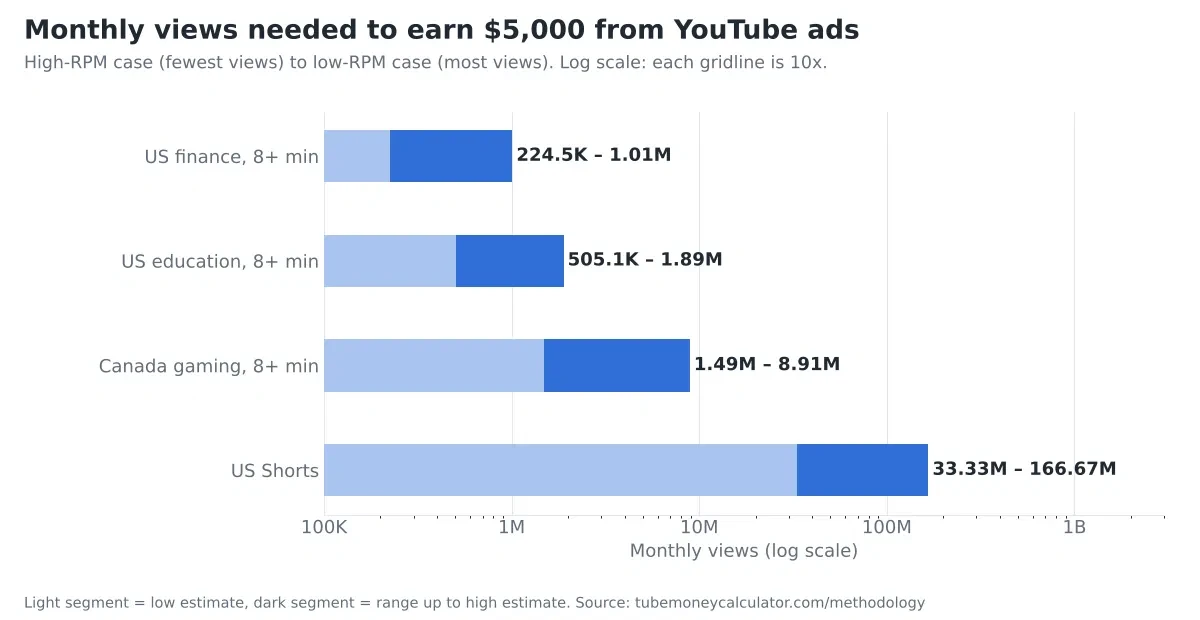
For a 1-million-subscriber channel, the question is simple: does its audience watch enough to reach the view level for the money you want? The subscriber count stays the same either way.
Seasons: the same channel in January and December
Advertising prices follow the calendar. Our model applies 0.75× in January and 1.35× in December. Take Channel A, earning $2,970 to $13,365 a month on average:
- January: 2,970 × 0.75 = $2,228 to 13,365 × 0.75 = $10,024
- December: 2,970 × 1.35 = $4,010 to 13,365 × 1.35 = $18,043
Across a full year, the calculator’s seasonal total of 12.12 gives $35,996 to $161,984 for Channel A, if the views stayed flat all year. In practice views change with the season too, so treat the yearly figure as a planning ceiling rather than a forecast. Our guide to why YouTube earnings drop in January covers the pattern.
Does the Gold Play Button pay?
The Gold Creator Award is given at 1,000,000 subscribers. According to YouTube’s Creator Awards Help page, it works like this:
- Discretionary. “Creator Awards are given at YouTube’s discretion,” and each channel is reviewed against the criteria.
- Conditional. Your channel must be active, with uploads in the last 6 months. It can’t have an active Community Guidelines violation, or one in the last 365 days, and can’t have active copyright strikes.
- Not cash. The award is a physical item, not a payment.
- Possibly costly to receive. You’re responsible for any customs duties or taxes in certain countries, and YouTube says it can’t cover them.
So the plaque is a milestone. It won’t change your monthly income, and you shouldn’t plan around it.
Money beyond ads
Once you’re in the Partner Program, several other sources can add to a million-subscriber channel’s income:
- Memberships, Super Chat, Super Stickers and Super Thanks. YouTube pays creators 70% of net revenue from these, once they turn on fan-funding features by accepting the Commerce Product Module (YouTube Help).
- YouTube Shopping, if you tag products or earn affiliate commission on sales.
- Brand deals. These are negotiated directly with sponsors. You must disclose paid promotion. In YouTube Studio, choose the paid-promotion setting in the video details (YouTube Help).
We don’t list rates for these, because they vary too much by audience and deal. Size them from your own numbers, not from a headline.
How to estimate your own 1-million channel in 5 steps
- Check your subscriber count and views. In Studio, note subscribers, then views for the last 28 days. Multiply by about 1.07 for a 30-day figure.
- Work out views per subscriber. Divide the 30-day views by your subscriber count.
- Split Shorts from long videos. Use the Content tab or the format filter in Analytics.
- Enter the numbers in the calculator. Use the Earnings Estimator for each part, with your niche, your main audience country and your video length.
- Compare with your real RPM. Work out your RPM in Studio (revenue ÷ views × 1,000). If it’s in the estimated range, the model fits your channel. If not, the “Know your real RPM” box shows where you sit.
For the Studio steps in more detail, see how to see your YouTube earnings in Studio.
What the February 1, 2027 changes mean at 1 million subscribers
If your channel is already in the Partner Program, the new entry bar doesn’t apply to you. Existing partners keep their place. You do need to accept the updated terms in YouTube Studio by January 31, 2027.
If you’re not in yet, the new bar is 1,000 subscribers plus 8,000 qualified watch hours in the last 365 days, or 20 million qualified Shorts views in the last 90 days. The fan-funding and Shopping thresholds are unchanged.
The Shorts rule matters most for channels like Channel C. From February 1, 2027, Shorts revenue sharing needs 10 million qualified Shorts views in the last 90 days. Below that line, the channel stays in the program and keeps earning on long-form, but its Shorts share pauses. Our 10 million Shorts views rule guide covers the detail.
FAQ
Do YouTubers get paid per subscriber?
No. Ad income comes from views and RPM. A subscriber count can show audience size and loyalty, but it doesn’t set the price of an ad or guarantee a view.
How much does a 1-million-subscriber channel make?
It varies widely. In our examples, the range runs from about $99 to $13,365 a month from ads, depending on how many views the channel gets, the niche, the audience country and the length of its videos.
Can a channel with 1 million subscribers earn less than one with 100,000?
Yes. A 100,000-subscriber channel with 500,000 views a month can out-earn a 1-million-subscriber channel with 150,000 views, especially in a higher-paying niche. Compare views per subscriber and RPM, not the subscriber count alone.
Does the calculator include sponsorships or memberships?
No. The calculator models ad revenue only. It doesn’t include memberships, Super Thanks, YouTube Premium, Shopping or brand deals. Your real income may be higher or lower than the ad estimate.
Your next step
Open the Earnings Estimator, enter your monthly views, niche, audience country and video length, and check the range against your Studio RPM. Then work out your views per subscriber. That single ratio will tell you more about your channel’s money than the subscriber count does.
All figures here are estimates from our published methodology, not official YouTube rates. Rules and award criteria checked November 3, 2026. YouTube may change them before February 2027.