Your Short took off. 100,000 views in two days, comments flooding in, subscribers climbing. You open YouTube Studio expecting your best week yet and find about $4.
Nothing is broken. So how much do YouTube Shorts pay per 1,000 views? In our calculator’s model, roughly $0.03 to $0.15 for a US audience — about $30 to $150 per million views, or 25 to 30 times less than the same views on a long video. The reason is structural: Shorts money doesn’t come from ads on your individual Short. It comes from a shared monthly pool, split across all eligible Shorts views after music rights are paid, and creators keep 45% of their slice. From February 1, 2027, sharing in that pool also requires 10 million qualified Shorts views in the last 90 days.
Here’s the whole picture, with the math.
Quick answer: what Shorts pay
| Shorts views | US audience | Canadian audience |
|---|---|---|
| 1,000 | $0.03 – $0.15 | $0.03 – $0.13 |
| 100,000 | $3 – $15 | $2.55 – $12.75 |
| 1,000,000 | $30 – $150 | $25.50 – $127.50 |
These are the ranges from our methodology, where Canada is counted at 0.85× the US rate. They’re estimates, not promises — your own figure depends on who watches and when.
Why Shorts pay so little: 5 reasons
1. It’s a shared pool, not ads on your video
With a long video, ads run on your video and you get a share of what those specific ads earned. Shorts don’t work that way. Ad money from the Shorts feed goes into a Creator Pool, which is then divided among creators based on their share of total eligible Shorts views (YouTube Help). Your Short is competing for a slice of one big pie, not earning its own.
2. The creator share is 45%, not 55%
Long-form watch-page ads pay creators 55% of net revenue. The Shorts share is 45% (YouTube Help). Same views, ten percentage points less of whatever reaches you.
3. Music takes a slice before you do
Before the pool is divided, money is set aside for music rights. A Short using one licensed track shares revenue with that rights holder; a Short using two shares more. That cost comes out before creators are paid.
4. Only certain views count
The split is based on engaged views of Shorts from monetizing creators. Loops, views on Shorts shown as ads, and views on non-eligible content don’t feed your slice. The number under your Short and the number that earns are not the same thing — we cover that gap in views vs engaged views.
5. No niche or length premium
This is the one people miss. A long video in a high-paying niche earns more per view than one in a low-paying niche, and a video of 8 minutes or longer can carry mid-roll ads. Shorts get neither. A finance Short and a prank Short draw from the same pool at the same rate, and no Short is long enough for a mid-roll.
How Shorts money is calculated (YouTube’s own example)
YouTube publishes a worked example on its Shorts monetization policies page. Simplified:
- Shorts feed ads bring in $100,000 in a month.
- About $10,000 goes to music licensing, leaving a $90,000 Creator Pool.
- A creator responsible for 1% of all eligible Shorts views is allocated $900.
- That creator keeps 45% of it: $405.
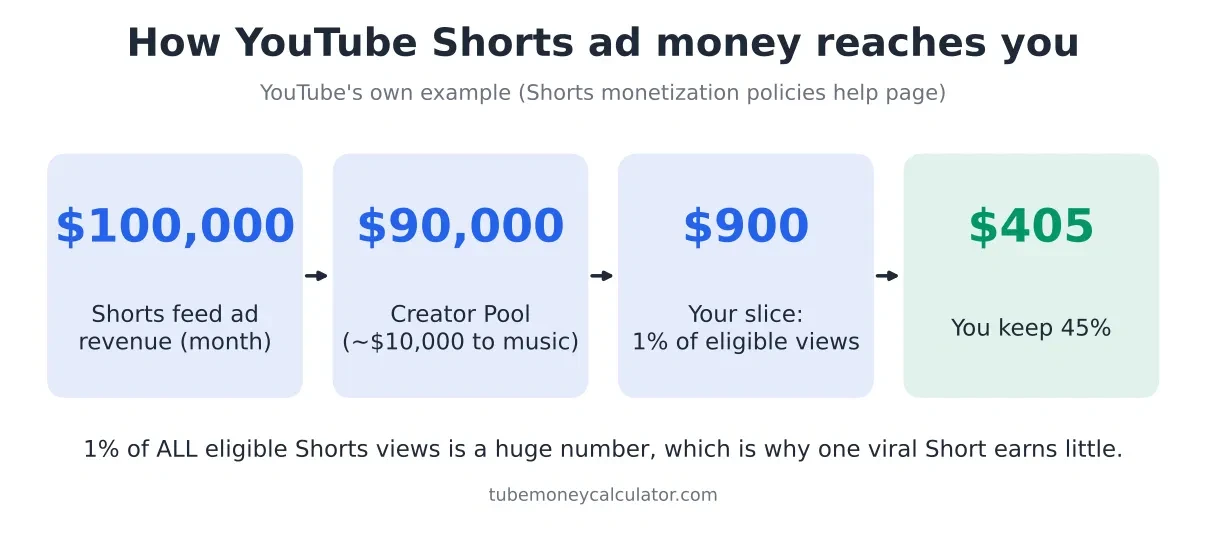
The step worth sitting with is number 3. One percent of all eligible Shorts views on YouTube is an enormous amount of viewing — far beyond what a single viral Short delivers. That’s why one hit Short produces a few dollars rather than a few hundred.
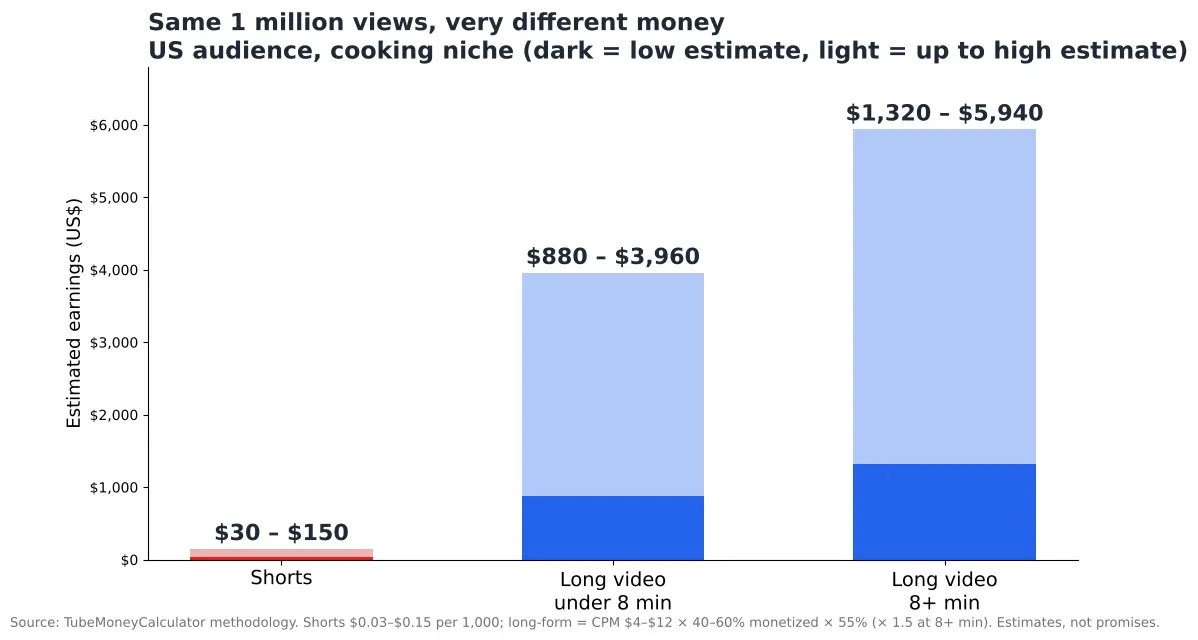
Worked example 1: 1 million views, Shorts vs long-form
A US cooking channel. Same million views, three different formats.
As Shorts: 1,000,000 ÷ 1,000 × $0.03 to $0.15 = $30 to $150
As a long video under 8 minutes:
- Low RPM: $4 CPM × 1.00 (US) × 40% monetized views × 55% creator share = $0.88 per 1,000
- High RPM: $12 × 1.00 × 60% × 55% = $3.96 per 1,000
- Total: $880 to $3,960
As a long video 8 minutes or longer (mid-roll boost of 1.5×):
- RPM $1.32 to $5.94 per 1,000
- Total: $1,320 to $5,940
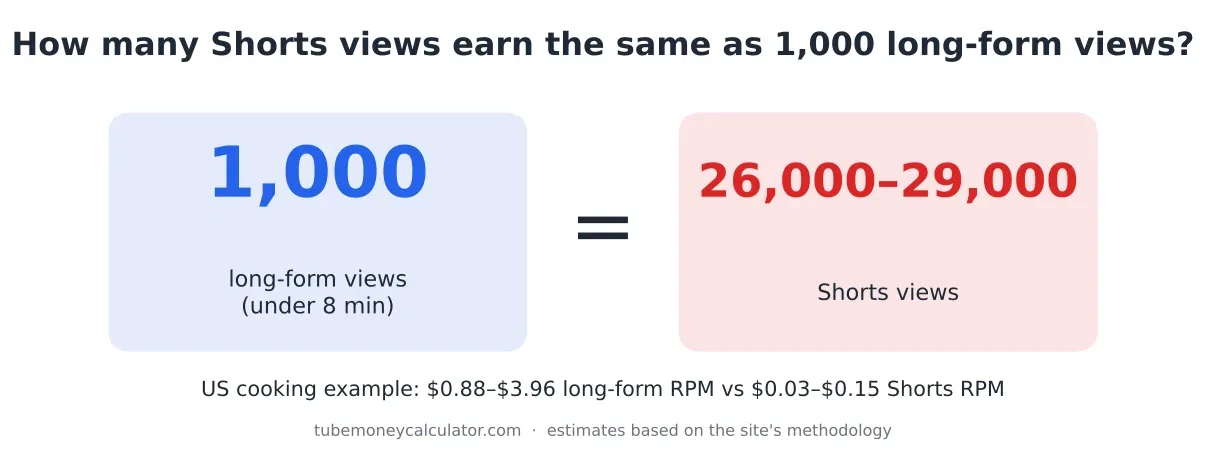
Turn that around and it gets clearer. To earn what 1,000 long-form views earn (under 8 minutes), you’d need roughly 26,000 to 29,000 Shorts views:
- $0.88 ÷ $0.03 × 1,000 ≈ 29,300 Shorts views
- $3.96 ÷ $0.15 × 1,000 ≈ 26,400 Shorts views
For context, AIR Media-Tech’s study of 274 channels reported a similar pattern — Shorts RPM at roughly 3–14% of long-form, needing about 11,000–34,000 Shorts views to match 1,000 long-form views. That’s their data, not ours, but it lands in the same place.
Worked example 2: a Canadian gaming channel
500,000 Shorts views in a month versus 50,000 long-form views (8+ minutes), Canadian audience, gaming niche:
Shorts: Canada rate $0.0255–$0.1275 per 1,000 → 500 × that = $12.75 to $63.75
Long-form, 8+ minutes:
- Low RPM: $2 CPM × 0.85 (Canada) × 40% × 55% × 1.5 = $0.561 per 1,000
- High RPM: $8 × 0.85 × 60% × 55% × 1.5 = $3.366 per 1,000
- 50,000 views → $28.05 to $168.30
So one tenth the views on long-form earned 2.2 to 2.6 times the money ($28.05 ÷ $12.75 = 2.2; $168.30 ÷ $63.75 = 2.6). That’s the trade every Shorts-first creator is making, usually without seeing the numbers.
The February 1, 2027 change: 10 million qualified Shorts views
From February 1, 2027, a channel needs 10 million qualified Shorts views in the last 90 days to share in Shorts ad and subscription revenue, per YouTube’s official announcement.
That’s a pace of about 3.33 million Shorts views a month. At the US rate, a channel sitting exactly at that line earns roughly $100 to $500 a month from Shorts. Below the line, the Shorts share becomes $0 — though the channel stays in the Partner Program and keeps earning on long-form, and the share resumes automatically once it’s back above 10 million.
New applicants face 20 million qualified Shorts views in 90 days as the Shorts route into the program. YouTube has mentioned incentives for channels under the threshold (Shopping bonuses, brand-deal incentives, trend boosts) but says details are coming later, so don’t plan around them. Full detail in YouTube’s 10 million Shorts views rule.
How to check your own Shorts RPM in YouTube Studio
- Open YouTube Studio and click Analytics.
- Open the Revenue tab.
- Find “How you make money” and look at the Shorts Feed ads line — that’s your Shorts pool income, including Premium revenue allocated to Shorts.
- Switch the content filter to Shorts and note your views for the same period.
- Divide: earnings ÷ views × 1,000 = your real Shorts RPM.
Remember that revenue takes about two days to appear and the finalized figure lives in AdSense for YouTube (YouTube Help). Do this monthly — your own number beats any published range.
How to earn more from the same Shorts views
- Use Shorts as a doorway. Attach a related long video to each Short. The Short earns pennies; the long video it sends viewers to earns 25–30× more per view.
- Mix in long-form deliberately. Not instead of Shorts — alongside. Shorts bring discovery, long videos bring watch hours and real RPM. Note that Shorts watch time doesn’t count toward the watch-hour requirement at all (details here).
- Consider original audio. Licensed music means sharing revenue with rights holders. Your own audio doesn’t.
- Make content that lands in higher-paying ad markets. The pool pays by views, but your country mix still shapes the revenue those views generate.
- Add income that doesn’t depend on the pool. Super Thanks, memberships and Shopping are paid by viewers directly, so they’re unaffected by Shorts rates.
- Track your RPM monthly. If it falls, check whether your country mix or your Shorts-to-long-form ratio changed before assuming YouTube cut rates.
Be realistic about the limits: none of this changes the pool rate. It changes how much of your audience’s attention you convert into something that pays better.
FAQ
Is $0.05 per 1,000 Shorts views normal?
Yes. That sits right inside the typical US range of $0.03–$0.15. Non-US audiences often land lower.
Do longer Shorts (up to 3 minutes) pay more per view?
YouTube hasn’t said that longer Shorts earn a higher rate, and the pool is split by views rather than by minutes. Don’t assume a length premium — there’s no mid-roll equivalent for Shorts.
Does using popular music hurt my Shorts earnings?
Money for music rights comes out before the Creator Pool is divided, and a Short using more tracks shares more. Original or royalty-free audio avoids that split.
Should I stop making Shorts?
Not if they’re bringing you viewers. Judge Shorts on reach and subscribers, not on their ad income, and make sure each one points somewhere that pays better.
Your next step
Open the YouTube Money Calculator, choose Shorts, and enter your real monthly Shorts views and audience country. Then run the same views as an 8+ minute video in your niche. The gap between those two numbers is the clearest argument for how to spend your next month of filming.
All figures here are estimates from our published methodology, not official YouTube rates. Your real earnings will differ.