Your channel gets about the same views as a finance creator’s. Their videos earn several times what yours do. Is it the niche, or something else? And if it’s the niche, should you switch?
The short answer: finance and business pay the most per view, and gaming, kids, comedy and music pay the least. In our model, a US video of 8 minutes or longer earns about $4.95 to $22.28 per 1,000 views in finance, and $0.66 to $2.97 in music. Niche is only one factor. Your audience’s country, your video length, your share of Shorts and how many views show an ad can matter just as much. Switching niches only makes sense if the numbers still work once you account for the views you would lose.
The full table: 20 niches
Here are all 20 niches in the calculator, sorted from highest to lowest RPM for long videos of 8 minutes or longer. The under-8-minute column drops the 1.5× mid-roll boost, which the methodology applies only to videos of 8 minutes or longer.
| Niche | CPM | RPM, under 8 min | RPM, 8+ min |
|---|---|---|---|
| Finance & investing | $15 – $45 | $3.30 – $14.85 | $4.95 – $22.28 |
| Business & marketing | $12 – $35 | $2.64 – $11.55 | $3.96 – $17.33 |
| Real estate | $10 – $28 | $2.20 – $9.24 | $3.30 – $13.86 |
| Technology | $8 – $22 | $1.76 – $7.26 | $2.64 – $10.89 |
| Education | $8 – $20 | $1.76 – $6.60 | $2.64 – $9.90 |
| Health & fitness | $7 – $18 | $1.54 – $5.94 | $2.31 – $8.91 |
| Automotive | $6 – $16 | $1.32 – $5.28 | $1.98 – $7.92 |
| Travel | $5 – $14 | $1.10 – $4.62 | $1.65 – $6.93 |
| Beauty & fashion | $5 – $13 | $1.10 – $4.29 | $1.65 – $6.44 |
| Food & cooking | $4 – $12 | $0.88 – $3.96 | $1.32 – $5.94 |
| DIY & crafts | $4 – $11 | $0.88 – $3.63 | $1.32 – $5.45 |
| News & politics | $4 – $11 | $0.88 – $3.63 | $1.32 – $5.45 |
| Sports | $3 – $10 | $0.66 – $3.30 | $0.99 – $4.95 |
| Entertainment | $3 – $9 | $0.66 – $2.97 | $0.99 – $4.46 |
| Pets & animals | $3 – $9 | $0.66 – $2.97 | $0.99 – $4.46 |
| Vlogs & lifestyle | $3 – $8 | $0.66 – $2.64 | $0.99 – $3.96 |
| Gaming | $2 – $8 | $0.44 – $2.64 | $0.66 – $3.96 |
| Kids & family | $2 – $7 | $0.44 – $2.31 | $0.66 – $3.47 |
| Comedy | $2 – $7 | $0.44 – $2.31 | $0.66 – $3.47 |
| Music | $2 – $6 | $0.44 – $1.98 | $0.66 – $2.97 |
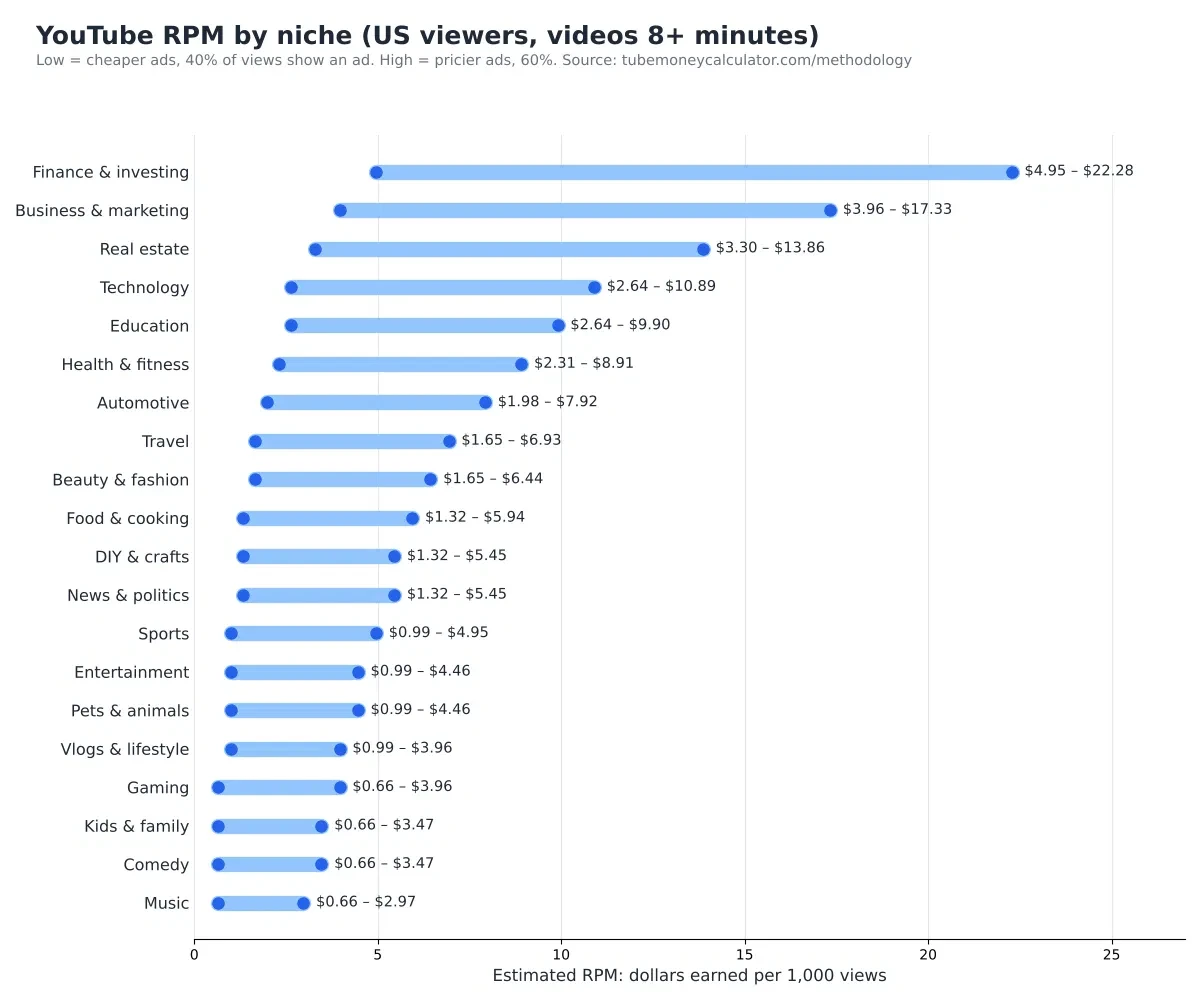
The spread is wide, so read the top and bottom with care. Finance’s high end is more than seven times music’s high end. But the middle of the table is crowded. Most niches land within a few dollars of each other, and the country and length choices can move a channel further than moving between two middle niches.
How a niche’s ad price becomes your RPM
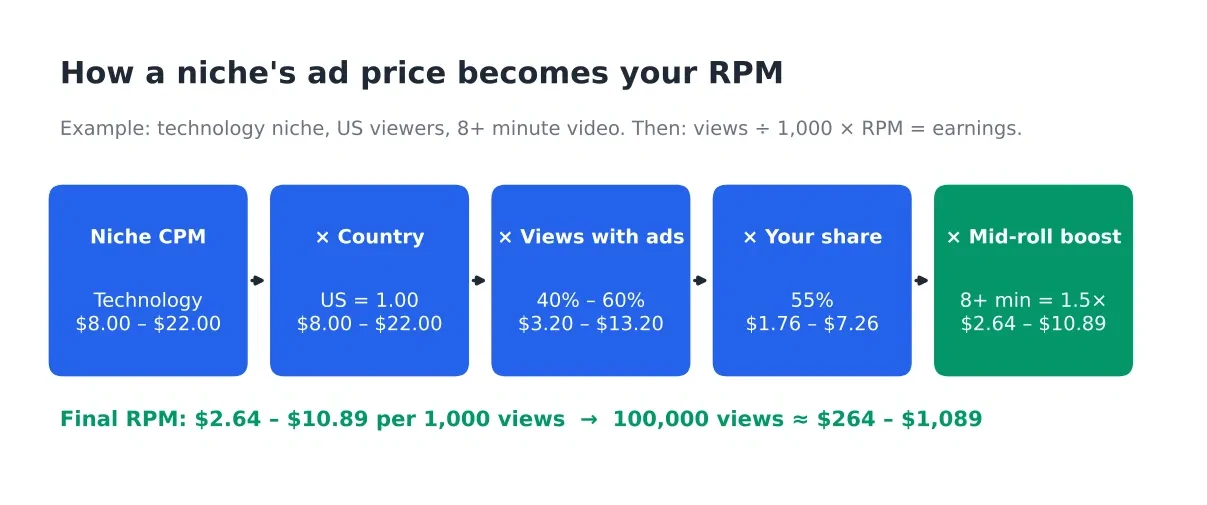
The calculator works in five steps. Here it is for technology, US viewers, 8+ minute videos:
- Start with the niche CPM. Technology is $8 to $22 per 1,000 ad impressions.
- Apply the country. US viewers are at 1.00, so nothing changes.
- Apply the share of views that show an ad. 40% at the low end, 60% at the high end. That gives $3.20 to $13.20.
- Apply your 55% creator share. That gives $1.76 to $7.26.
- Apply the mid-roll boost for videos of 8 minutes or longer: 1.5×. That gives $2.64 to $10.89 per 1,000 views.
Then your monthly earnings are views ÷ 1,000 × RPM. At 100,000 views, that’s $264 to $1,089.
The 40% and 60% figures are an assumption in our model, not something YouTube publishes for each channel. If RPM and CPM still blur together, YouTube RPM explained covers the difference. YouTube’s own help page explains that not every view shows an ad, and lists reasons such as ad blockers and content that can’t be monetized (YouTube Help).
Why some niches pay more
Advertisers pay for the audience they reach, not for the video itself. A finance viewer may be about to make a large purchase or move money, which makes an ad valuable to a financial firm. A gaming viewer may be watching for fun, so the same ad slot is worth less to most advertisers.
Some niches have hard limits. Personalized ads are prohibited for content set as made for kids, according to YouTube’s ads on made-for-kids content page. That’s why kids and family content sits at the bottom of the table.
Advertiser-friendly rules also matter. YouTube’s guidelines describe content that may receive “limited ad earnings” or “no ad earnings” (advertiser-friendly guidelines). Topics that are sensitive or controversial can lower earnings even within a high-paying niche.
Worked example 1: gaming vs finance, 100,000 views
Two US channels, each with 100,000 views a month on 8-minute-plus videos.
Gaming: 100 × $0.66 = $66 low, 100 × $3.96 = $396 high.
Finance: 100 × $4.95 = $495 low, 100 × $22.27 = $2,227.50 high.
For a finance channel to match what the gaming channel earns at the high end, it would need 396 ÷ 22.275 × 1,000 ≈ 17,800 views. To match the low end, it would need 66 ÷ 4.95 × 1,000 ≈ 13,300 views. So a finance channel with about 13,300 to 17,800 views earns what a gaming channel with 100,000 views does.
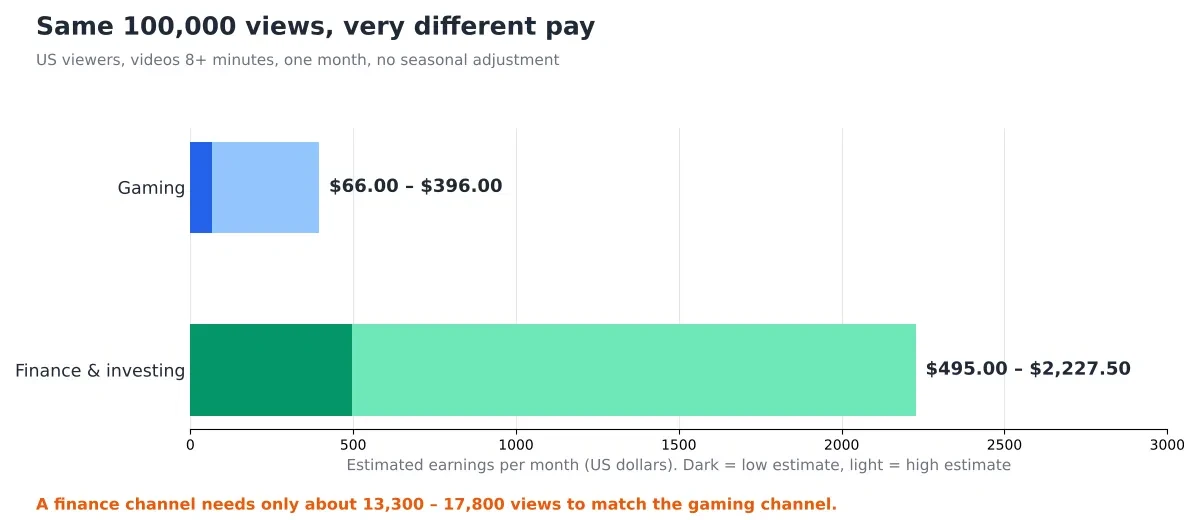
Read that carefully. The finance channel doesn’t need more people watching. It needs far fewer views to match the same money, which is exactly why niche choice gets so much attention. But it also says nothing about whether you can make finance videos that people watch.
Worked example 2: Canadian cooking vs Canadian tech, 50,000 views
Now the same two niches with a Canadian audience, which is counted at 0.85× the US rate, on 50,000 views a month of 8-minute-plus videos.
Cooking: 1.32 × 0.85 = $1.122 per 1,000 → 50 × $1.122 = $56.10 low; 5.94 × 0.85 = $5.049 per 1,000 → 50 × $5.049 = $252.45 high.
Tech: 2.64 × 0.85 = $2.244 per 1,000 → 50 × $2.244 = $112.20 low; 10.89 × 0.85 = $9.2565 per 1,000 → 50 × $9.2565 = $462.83 high.
Tech roughly doubles cooking at both ends. Both numbers are below the US figures for the same views, because of the Canadian multiplier. Switching from cooking to tech would roughly double the ad money per view, if the same viewers keep watching.
Worked example 3: the cost of starting over
This example shows why switching isn’t free. Say you run an established US gaming channel with 100,000 views a month. You consider starting a finance channel, which from zero might draw 10,000 views a month while it builds.
- Existing gaming channel: $66 to $396 a month.
- New finance channel at 10,000 views: 10 × $4.95 = $49.50 low, 10 × $22.275 = $222.75 high.
The new finance channel earns less than the gaming channel does today, at both ends, even with a much richer niche. And it earns nothing from ads until it joins the Partner Program. Today that needs 1,000 subscribers plus 4,000 qualified watch hours in 12 months, or 10 million qualified Shorts views in 90 days (YouTube Help). From February 1, 2027, new applicants will need 8,000 qualified watch hours in 365 days, or 20 million qualified Shorts views in 90 days (YouTube Blog).
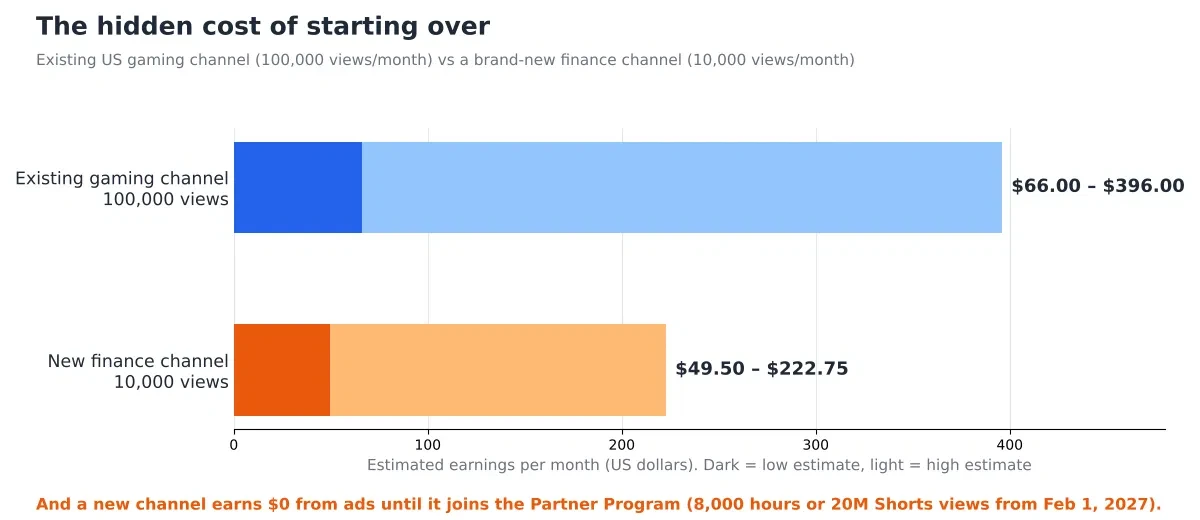
That’s the hidden cost of starting over. You give up an audience that already earns and take on a long climb to rebuild one.
Why a “high-paying niche” can still pay you badly
The table is a model, not a promise. Three things can make a high-CPM niche underdeliver:
Your audience may not match the niche’s buyers. A finance channel with a mostly student audience in low-paying countries will earn far less than the table suggests.
Real channels don’t match the model. A study by AIR Media-Tech covering about 300 channels, from May 2025 to May 2026, reported median RPMs by niche that differ from our model. It put Education & Science top at $10.22, Gaming at $2.05 and Kids & Teens lowest at $0.33. Its Business & Finance figure, $2.01, comes from only three channels, so the source itself calls it directional (AIR Media-Tech). Real data is messier than any CPM table, which is why a range beats a single number.
Shorts don’t follow the niche at all. Our model uses one US Shorts range, $0.03 to $0.15 per 1,000 views, for every niche. A Shorts-heavy finance channel can earn far less than its long-form niche suggests.
Season and country move the number too. December pays about 1.35× a normal month in our model, and January about 0.75×. Our January earnings article covers that pattern. And a 60% US audience pays very differently from a 60% audience in lower-paying countries. See YouTube RPM by country.
Should you switch niches? A 6-step test
Don’t switch on a table. Test it.
- Get your current RPM. In YouTube Studio, go to Analytics → Revenue and divide revenue by views, times 1,000, for the last 28 days. Split it by Shorts and long videos (how to see your earnings in Studio).
- Run the calculator for your current niche. Use your real country mix, length and format, and compare the range with your real RPM.
- Run the calculator for the target niche, with the same country mix, length and format.
- Work out the views you’d need. Divide your current monthly earnings by the target RPM to see how many views you’d need to earn the same money.
- Estimate honestly. Could you realistically reach that many views in the niche? Look at how your existing audience responds to new topics before answering.
- Test before you commit. Make three to five videos in an adjacent topic, then compare their RPM and views after 28 days. Only switch if the numbers hold.
If step 4 asks for far more views than you can realistically get, the switch doesn’t pay, whatever the table says.
5 ways to raise your RPM without changing niche
- Make longer videos when the topic needs them. The mid-roll boost starts at 8 minutes. Padding a video to get there doesn’t help, because viewers leave. A tight 8-minute guide beats a stretched 12-minute one.
- Pick buyer-intent topics inside your niche. A gaming channel that reviews hardware and accessories reaches viewers closer to buying, which can attract better ads.
- Focus on the countries that pay. If your content travels well to US and Canadian viewers, make choices that serve them: prices, brands and references that match their markets.
- Stay advertiser-friendly. Content flagged as “limited ad earnings” loses money even when views are strong. Review the guidelines before you publish sensitive topics.
- Plan around the calendar. Build your biggest uploads for October through December, when our model’s seasonal factor is highest.
None of these involve tricks. They work by making better videos for the audience you already have.
Find your own niche RPM in YouTube Studio
Divide your estimated revenue by views and multiply by 1,000, for the last 28 days, split by long videos and Shorts. The full walkthrough is in how to see your YouTube earnings in Studio.
FAQ
Which YouTube niche pays the most?
In our model, finance and investing has the highest range, at $4.95 to $22.28 per 1,000 views for US videos of 8 minutes or longer. Business and marketing comes next. But the top niche only pays if its audience and length fit, so the niche isn’t the whole answer.
Which niche pays the least?
Music, comedy, kids and family, and gaming sit at the bottom of the model. Kids content also can’t show personalized ads.
Does my niche set my RPM?
It sets the starting point. Country, length, Shorts share, the share of views that show an ad, and the month all change the result. Check your real RPM in Studio before deciding anything.
Should I switch to a higher-paying niche?
Only after the 6-step test shows that the views you’d need are realistic. Switching throws away an audience that already watches you, so the cost is real.
Can I earn more without changing topics?
Yes. Longer useful videos, buyer-intent subjects, a US or Canadian audience, advertiser-friendly content and smart timing can all raise RPM within your niche.
Your next step
Open the Earnings Estimator and run your current niche, then the niche you’re considering. Use your real country mix and video length. If the target niche only wins by a little, stay where you are and improve your current videos. If it wins by a lot and the views look realistic, test three to five videos before you commit.
All figures are estimates from our published methodology, not official YouTube rates. Third-party figures come from the sources named above, each using its own method. Rules checked November 2, 2026. YouTube may change them before February 2027.