You open YouTube, scroll for five minutes, and see three videos with three different stories. One says monetized channels under 8,000 hours get kicked out on February 1, 2027. Another says Shorts are “being demonetized.” A third says you won’t earn a cent until you hit 8,000 hours. If you’re a small creator, it’s easy to feel like the ground just moved under you.
I went back to YouTube’s own announcement and Help pages and checked the most common claims one by one. Most of the scary ones are wrong. A few real changes do matter, and two of them have deadlines.
Quick answer
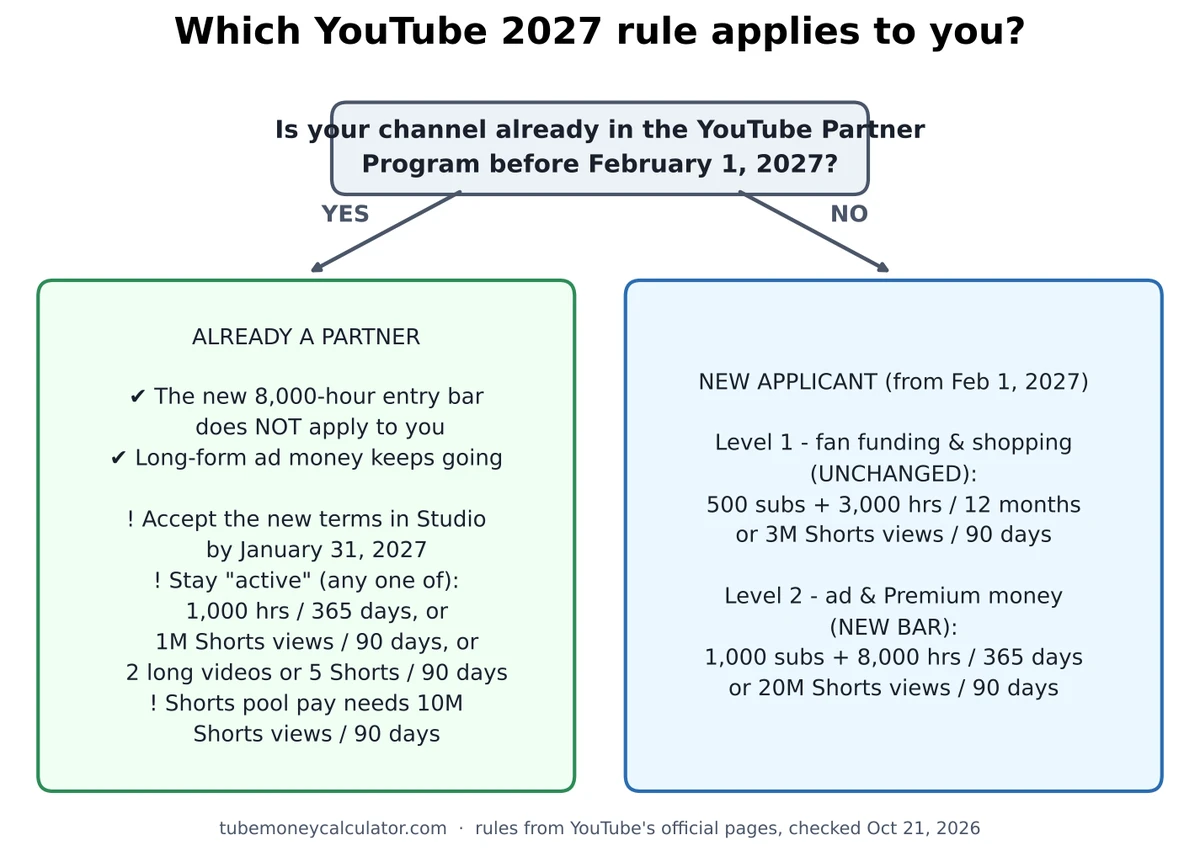
If you’re already in the YouTube Partner Program, the new 8,000-hour entry bar does not apply to you. Your long-form ad money keeps going. What you must do is accept the updated terms in YouTube Studio by January 31, 2027, and stay “active” under a new, fairly low activity rule. If you’re not in yet, the bar for ad money goes up on February 1, 2027, but the 500-subscriber level for fan funding and shopping does not change. (YouTube Help: Changes to the YouTube Partner Program)
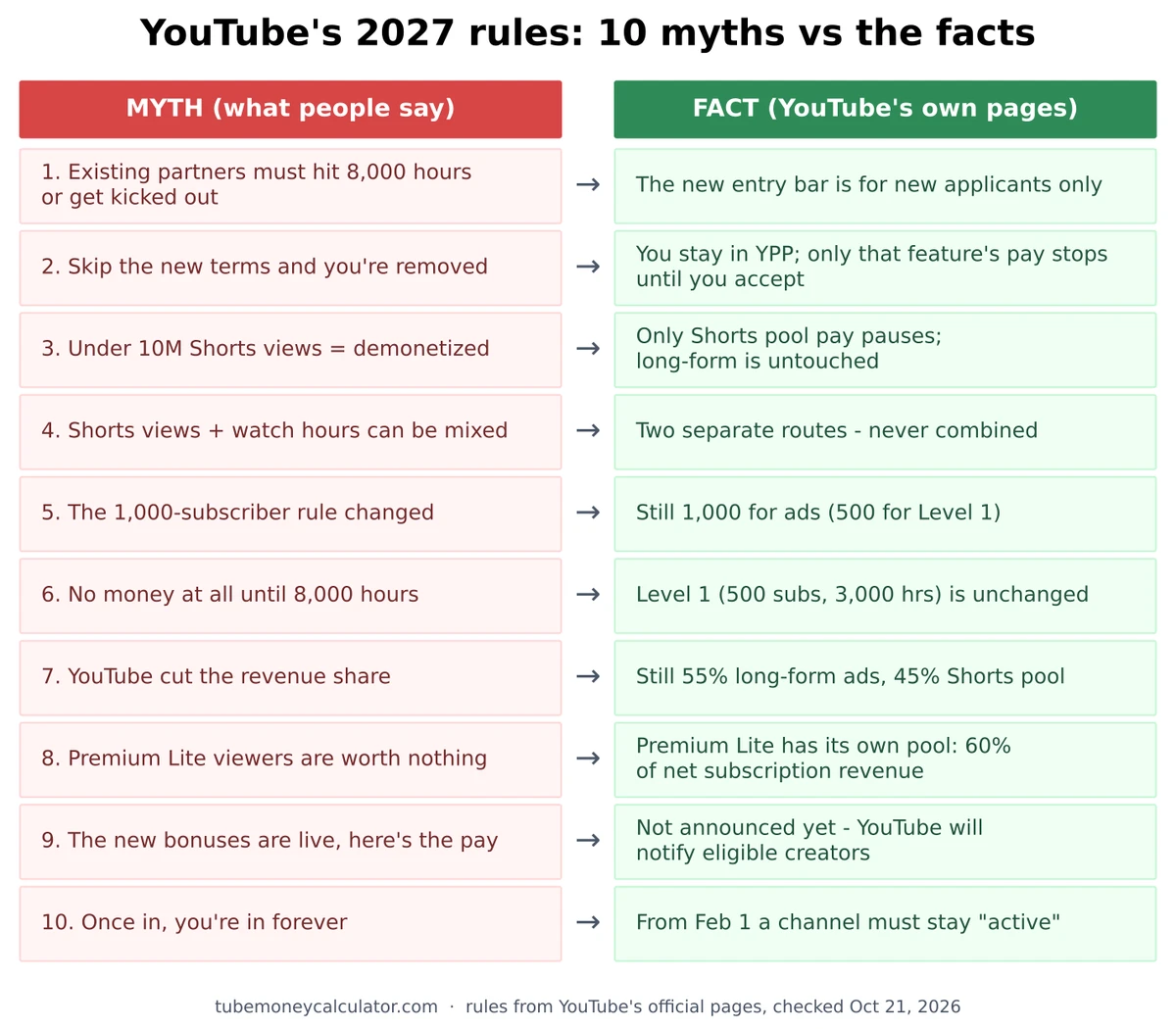
Below are the 10 myths I see most often, each with the fact from YouTube’s official pages. After that, two worked examples with real numbers show what the changes mean in dollars.
Myth 1: “Monetized channels under 8,000 watch hours get kicked out on February 1”
False. The 8,000-hour number is an entry requirement for new applicants. YouTube’s announcement says plainly: “This update won’t impact creators already in YPP.” (YouTube Blog)
So if you joined with 4,000 hours in 2025 or 2026, you don’t need to re-qualify at 8,000. You keep your place. The things that do still apply to you are the terms deadline (Myth 2), the Shorts rule (Myth 3) and the activity rule (Myth 10).
For the full list of what changes and what doesn’t, see our plain-English guide to the YouTube Partner Program changes in February 2027.
Myth 2: “If you don’t accept the new terms, you’re removed from the program”
False, but don’t skip them. YouTube asks every partner to review and accept updated terms in YouTube Studio by January 31, 2027. The terms come in parts called “modules”: the Watch Page Monetization Module (long-form ads), the Shorts Monetization Module and, where it applies, the Commerce Product Module (fan funding and shopping).
Here’s what YouTube’s Help page says happens if you don’t accept:
- You are not removed from the Partner Program.
- From February 1, 2027, you stop earning from the features tied to the terms you didn’t accept.
- You can get that money back flowing by accepting the terms later in YouTube Studio.
So nobody gets thrown out, but a missed click could mean missed income. If you run a channel, put a reminder in your calendar for early January. If you’re managed by a network (MCN), check who has to accept: for owned-and-operated channels the network accepts; for affiliate channels the channel itself does. (YouTube Help)
Myth 3: “Shorts are being demonetized” / “Under 10 million Shorts views and you’re out”
False. From February 1, 2027, a partner needs at least 10 million qualified Shorts views in the last 90 days to earn from the Shorts Creator Pool (ads and Premium money on Shorts). If you’re below that:
- You stay in the Partner Program.
- Your long-form earnings are not affected.
- Shorts revenue sharing turns back on automatically when you’re above 10 million again.
It’s a rolling 90-day window, so you can drop below and come back. YouTube also announced a new Targeted Shorts Ads option: when an advertiser targets an ad to five or fewer channels, eligible creators get a direct 45% share of that ad money, on top of normal pool earnings. (YouTube Help)
We break down the numbers in YouTube’s 10 million Shorts views rule explained. Worked example 1 below shows what it means in dollars.
Myth 4: “You can add your Shorts views and watch hours together”
False. New applicants have two separate routes to the ad level:
| Route | What you need | Time window |
|---|---|---|
| Long-form route | 1,000 subscribers + 8,000 qualified watch hours | Last 365 days |
| Shorts route | 1,000 subscribers + 20 million qualified Shorts views | Last 90 days |
You meet one route or the other. They are never combined. And watch time from the Shorts feed does not count toward watch hours at all. (YouTube Help: Partner Program overview)
If you have big Shorts numbers but few hours, read Do YouTube Shorts count toward watch hours?
Myth 5: “The subscriber requirement changed too”
False. The ad level still needs 1,000 subscribers. The fan-funding and shopping level still needs 500 subscribers. Only the watch-hours and Shorts-views numbers for the ad level went up (from 4,000 hours to 8,000, and from 10 million Shorts views to 20 million). (YouTube Help)
Myth 6: “You can’t earn anything until you hit 8,000 hours”
False. The first level of the Partner Program is unchanged. With 500 subscribers plus either 3,000 qualified watch hours in the last year or 3 million qualified Shorts views in the last 90 days, you can apply for fan funding (channel memberships, Super Chat, Super Thanks), YouTube Shopping and Creator Partnerships. (YouTube Help)
That is less than half of the new 8,000-hour bar. It won’t replace ad money for most small channels, but it means you aren’t working for free the whole way. Our guide to making money before 8,000 watch hours walks through each option.
Myth 7: “YouTube cut the revenue share, so every view pays less”
False. YouTube’s Help page still lists the same splits: creators get 55% of net ad revenue on long-form videos, and 45% of the revenue allocated to them from the Shorts Creator Pool. (YouTube Help: Partner earnings overview) YouTube’s announcement also says it expects to pay creators more in 2027 than in 2026. That is YouTube’s forecast, not a promise for your channel.
What changed is who gets in and when Shorts pay, not how much a qualifying view is worth. On our calculator, a US tech video of 8+ minutes still estimates $2.64 to $10.89 per 1,000 views before and after February 1 (methodology). If your Studio numbers dip in February, look at the calendar first. Worked example 2 shows why.
New to RPM? Start with YouTube RPM explained.
Myth 8: “Premium Lite viewers don’t see ads, so they’re worth nothing to me”
False. Premium Lite is expanding to every country where YouTube Premium is sold, and it gets its own money pool. YouTube puts 60% of net Premium Lite subscription revenue into a creator pool (Premium’s pool is 30%). The pool is shared out by how much members watch, and creators get 55% on long-form and 45% on Shorts. YouTube says that, based on 2026, partners on average earn more when someone subscribes to Premium than when that person would have watched ads. (YouTube Blog)
Two honest caveats. YouTube hasn’t announced a launch date for the expansion. And you only share in Premium money once you’re in the ad level of the program. More in Does YouTube Premium pay creators?
Myth 9: “The new Shorts bonuses are live, and here’s how much they pay”
Not announced yet. YouTube says channels below the 10 million Shorts mark may get new incentives: bonuses for YouTube Shopping, production credits for brand deals, and earnings boosts for starting trends. It also says eligible creators will be told how to opt in. (YouTube Help)
As of October 21, 2026, YouTube has not published amounts, rules or a start date. If a video tells you exactly what these bonuses pay, ask where the number came from.
Myth 10: “Once you’re in the program, you’re in forever”
False, and this one is new. From February 1, 2027, a channel counts as active if it meets any one of these:
- 1,000 qualified watch hours in the past 365 days
- 1 million qualified Shorts views in the last 90 days
- 2 long-form videos or 5 Shorts uploaded every 90 days
If a channel falls below, YouTube gives an extended 90-day window to get back above the watch-hours or Shorts-views mark. (YouTube Help) The bar is low. Posting two long videos every three months keeps you safe. It mainly catches channels that have gone quiet.
What the changes mean in dollars: 3 worked examples
These use the same numbers as our YouTube earnings calculator and its methodology page. They are estimates, not promises. Real earnings depend on your audience, your ads and your retention.
Example 1: A US tech channel already in the program, with small Shorts numbers
Say you run a US tech channel. Each month you get 50,000 views on long videos (8+ minutes) and 1 million views on Shorts. That’s about 3 million Shorts views every 90 days, well under 10 million.
Step 1: Long-form RPM (earnings per 1,000 views)
- Tech CPM on the calculator: $8.00 (low) to $22.00 (high)
- US country factor: × 1.00 → $8.00 to $22.00
- Share of views that show ads: × 40% (low) or 60% (high) → $3.20 to $13.20
- Your 55% share → $1.76 to $7.26
- Mid-roll boost for 8+ minute videos: × 1.5 → $2.64 to $10.89 RPM
Step 2: Long-form money: 50,000 ÷ 1,000 × $2.64 to $10.89 = $132 to $544.50 a month
Step 3: Shorts money: the calculator’s US Shorts RPM is $0.03 to $0.15. 1,000,000 ÷ 1,000 × $0.03 to $0.15 = $30 to $150 a month
| Before Feb 1, 2027 | From Feb 1, 2027 | |
|---|---|---|
| Long-form ads | $132 – $544.50 | $132 – $544.50 (unchanged) |
| Shorts pool share | $30 – $150 | $0 (paused while under 10M / 90 days) |
| Total per month | $162 – $694.50 | $132 – $544.50 |
| Still in the Partner Program? | Yes | Yes |
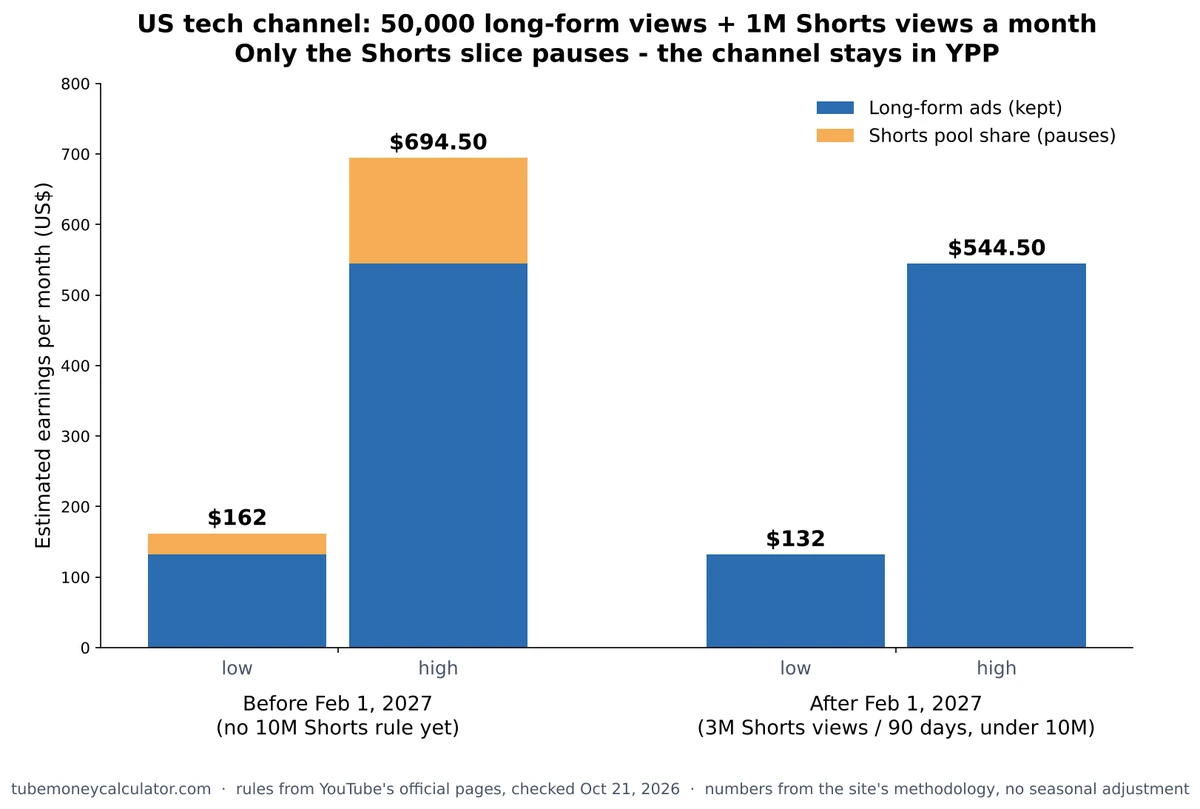
The channel loses about a fifth of its estimated income, not all of it. To get Shorts pay back, it would need 10,000,000 ÷ 90 ≈ 111,000 Shorts views a day, versus about 33,000 today. For most solo creators, the better move is to put that time into long videos, where each view is worth 18 to 73 times more ($2.64 ÷ $0.15 ≈ 18; $10.89 ÷ $0.15 ≈ 73).
Example 2: “My February earnings crashed, so the new rules cut my pay”
This is the myth I expect to see most in February 2027. Same US tech channel, same 50,000 long-form views every month. Now switch on the calculator’s seasonal option. Advertisers spend most before the holidays and least right after them.
| Month | Seasonal factor | Estimated earnings |
|---|---|---|
| December | × 1.35 | $178.20 – $735.08 |
| January | × 0.75 | $99.00 – $408.38 |
| February | × 0.82 | $108.24 – $446.49 |
| March | × 0.92 | $121.44 – $500.94 |
The math for February: $132 × 0.82 = $108.24, and $544.50 × 0.82 = $446.49. From December to February, estimated earnings fall about 39% (1 − 0.82 ÷ 1.35 = 0.393), with zero change in views and zero change in rules.
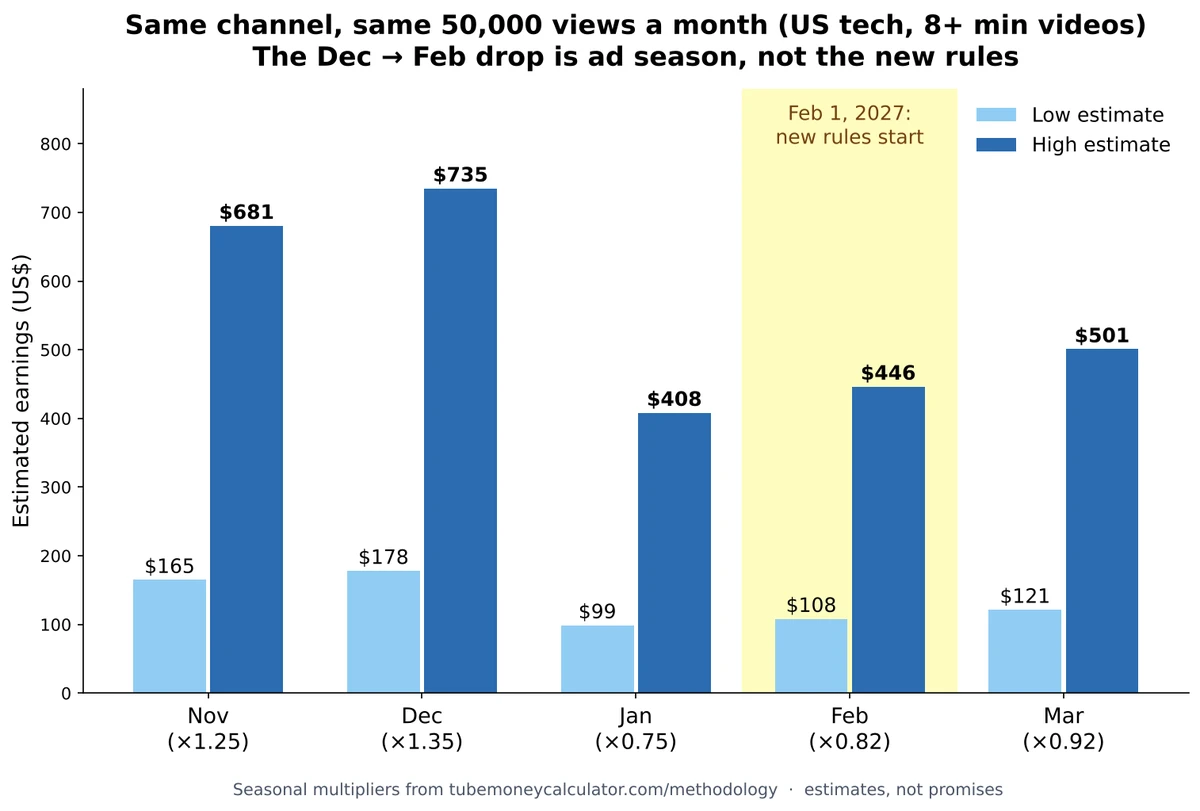
So before you blame the new rules, compare February 2027 with February 2026 in YouTube Studio, not with December.
Example 3: A new Canadian cooking channel, Level 1 vs the new ad level
You start a cooking channel with a mostly Canadian audience. Your videos are about 10 minutes long, and viewers watch about 5 minutes on average.
Level 1 (fan funding, shopping): 3,000 hours × 60 = 180,000 minutes. 180,000 ÷ 5 = 36,000 views in 12 months, or about 3,000 a month.
Ad level (new bar): 8,000 hours × 60 = 480,000 minutes. 480,000 ÷ 5 = 96,000 views in 365 days, or about 8,000 a month, every month.
What those 8,000 monthly views could earn in ads once you qualify:
- Cooking CPM: $4.00 to $12.00
- Canada factor × 0.85 → $3.40 to $10.20
- × 40% or 60% of views with ads → $1.36 to $6.12
- × 55% creator share → $0.75 to $3.37
- × 1.5 mid-roll boost → $1.12 to $5.05 RPM
- 8,000 ÷ 1,000 × $1.12 to $5.05 = about $9 to $40 a month
That’s honest, and it’s small. It shows why Level 1 matters: you can turn on memberships and Super Thanks at under half the watch hours, then grow into ad money. For a full plan, see how long it takes to get 8,000 watch hours and our 90-day growth plan for solo creators.
What to actually do before February 1, 2027
- Already in the program? Open YouTube Studio, go to the Earn section and accept all the updated terms modules. Do it in early January at the latest; the deadline is January 31, 2027.
- Check your Shorts number. In YouTube Studio, look at your qualified Shorts views for the last 90 days. If you’re far below 10 million, plan for long-form to carry your income.
- Check you’re “active.” Two long videos or five Shorts every 90 days is enough. Put it on your calendar.
- Not in yet? Aim for Level 1 first (500 subscribers and 3,000 hours, or 3 million Shorts views). Then work toward 8,000 hours with a steady upload plan.
- Ignore exact bonus numbers until YouTube publishes them, and recheck the official pages in January. The rules could still be updated.
FAQ
If I apply in January 2027 and the review isn’t done by February 1, which rules apply?
YouTube hasn’t said. Its Help page does not explain how applications already in progress will be judged, and reviews “typically” take about a month. If you already qualify, applying by the end of December gives you the best chance. See Should you apply before February 1, 2027?
Will my old videos keep earning after February 1?
Yes, if you’re already a partner and you’ve accepted the Watch Page Monetization terms. Long-form ad earnings are not affected by the new entry bar or the Shorts rule.
Does the old “no uploads for 6 months” rule still apply?
YouTube’s eligibility page still says monetization may be turned off for channels with no uploads or Posts in 6 months or more. From February 1, 2027, the new activity rule above also applies. The safe habit is simple: keep posting at least every few weeks. (YouTube Help)
Does the 2027 update change YouTube’s ad rates?
No. The rules decide who can earn and when Shorts pay. Ad rates still move with your niche, your audience’s country and the time of year.
Does your calculator include the new rules?
The calculator estimates what qualifying views earn. If your channel is under 10 million Shorts views in 90 days after February 1, treat its Shorts estimate as $0 until you’re back above the mark. It doesn’t include Premium money. Read how the calculator works for the details.
Your next step
Open the Earnings Estimator, enter your real monthly long-form views, niche and audience country, and switch on the seasonal option. That gives you a fair baseline, so a quiet February doesn’t send you into a panic.
Sources
- New opportunities to earn and changes to the YouTube Partner Program — YouTube Blog, August 10, 2026
- Changes to the YouTube Partner Program — YouTube Help
- YouTube Partner Program overview & eligibility — YouTube Help
- YouTube partner earnings overview — YouTube Help
- TubeMoneyCalculator methodology — all earnings numbers
All rules checked against YouTube’s official pages on October 21, 2026.