You post a Short every day. One of them takes off and pulls in 400,000 views. You open YouTube Studio, check your watch hours for monetization, and the number has barely moved. It feels like the system is broken.
It isn’t broken. It’s just counting something different from what most of us assume.
The short answer: No. Time people spend watching your Shorts in the Shorts feed does not count toward YouTube’s watch-hour requirement. Shorts have their own separate route, measured in views, not hours. Starting February 1, 2027, new channels need 8,000 qualified watch hours from long-form videos in the last 365 days, or 20 million qualified Shorts views in the last 90 days, and the two numbers never add together.
That doesn’t mean Shorts are useless for a small channel. Below I’ll show you exactly what counts, the math for both routes, and a step-by-step way to use Shorts to feed your long-form watch hours instead of competing with them.
What counts as a watch hour (and what doesn’t)
YouTube explains this on its Partner Program overview and eligibility page and in an August 2026 explainer on qualified watch hours and Shorts views. Here is the plain-English version:
| Counts toward watch hours | Does NOT count toward watch hours |
|---|---|
| Public long-form videos | Shorts watch time |
| Podcasts uploaded as long-form videos | Private and unlisted videos |
| Live streams that are archived (kept on your channel) | Deleted videos (their hours disappear too) |
| Views from ads you paid to run | |
| Live streams that weren’t archived |
Shorts views follow their own rules. To count, a Short must be public, and the view must be an engaged view, meaning the viewer kept watching past the first few seconds. Loops and replays don’t add extra views. (If the difference between views and engaged views confuses you, I wrote a full guide: Views vs Engaged Views: Which Number Counts for the 2027 Rules?)
One more detail that trips people up: the two routes are kept apart in both directions. Shorts watch time isn’t a long-form watch hour, and views on your long videos aren’t Shorts views.
The two routes into YouTube ad money from February 1, 2027
According to YouTube’s official announcement and the Changes to the YouTube Partner Program help page, new creators who want ad and Premium revenue sharing will need 1,000 subscribers plus one of these:
- 8,000 qualified watch hours from long-form videos in the last 365 days, or
- 20 million qualified Shorts views in the last 90 days.
Today’s rule (until January 31, 2027) is 4,000 hours or 10 million Shorts views. Creators already in the Partner Program don’t have to requalify.
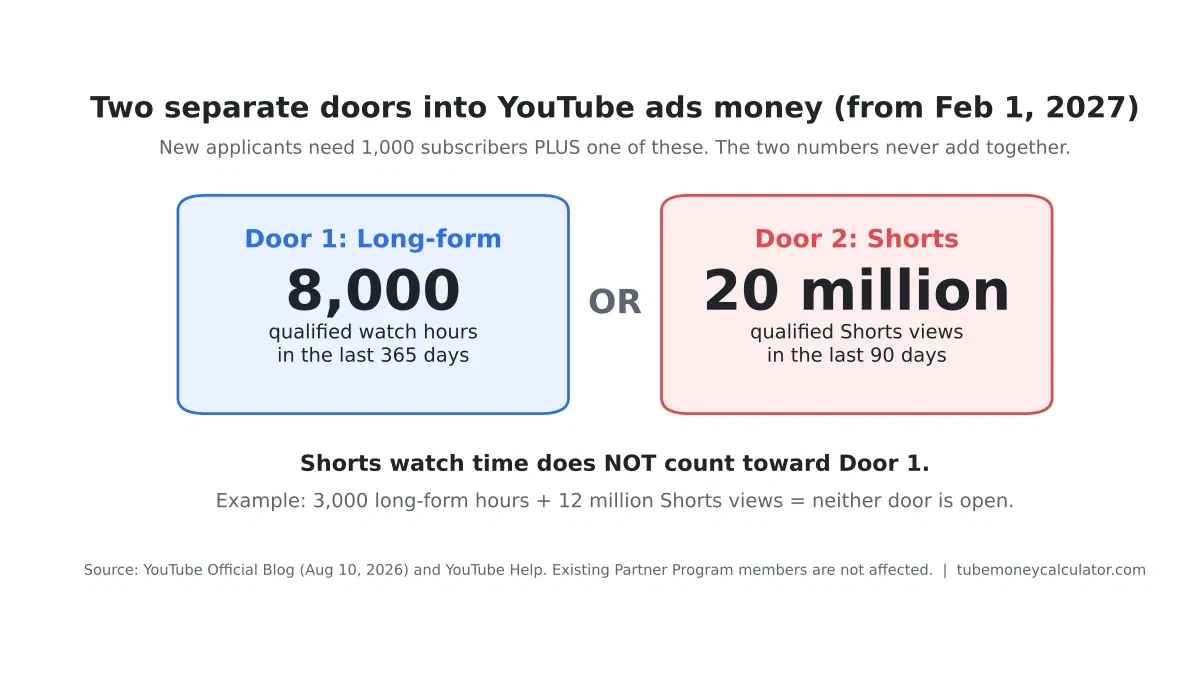
Here’s why this matters. Picture a channel with 3,000 long-form watch hours and 12 million Shorts views. It feels like it should qualify; that’s a lot of attention. But for ad revenue it hasn’t passed either bar, because 3,000 is short of 8,000 and 12 million is short of 20 million. The numbers don’t combine.
(That same channel could still unlock the lower level of the program. The 500-subscriber level for fan funding and Shopping stays at 3,000 watch hours or 3 million Shorts views, and that threshold is unchanged in 2027. More on that in How to Make Money on YouTube Before You Reach 8,000 Watch Hours.)
Which route is realistic for a one-person channel? The math
Let’s put both routes side by side with simple numbers.
Worked example 1: the Shorts route (20 million views in 90 days)
- 20,000,000 views ÷ 90 days = about 222,222 qualified views every single day
- If you post one Short a day for 90 days, that’s 90 Shorts.
- 20,000,000 ÷ 90 Shorts = about 222,222 engaged views per Short, on average
And it’s a rolling 90-day window, so you have to hit that pace for three months straight. A few viral Shorts can do it, but for most solo creators that is not a plan you can count on.
Worked example 2: the long-form route (8,000 hours in 365 days)
First, turn hours into minutes: 8,000 hours × 60 = 480,000 minutes.
Now divide by how long the average viewer watches (your “average view duration” in Studio):
- If people watch 4 minutes on average: 480,000 ÷ 4 = 120,000 views a year, which is 10,000 views a month.
- If people watch 6 minutes on average: 480,000 ÷ 6 = 80,000 views a year, which is about 6,667 views a month.
Spread across two long videos a week (104 videos a year):
- At 4 minutes average: 120,000 ÷ 104 = about 1,154 views per video
- At 6 minutes average: 80,000 ÷ 104 = about 769 views per video
That’s still hard work, but notice the difference: roughly 800 to 1,200 views per long video, versus about 222,000 views per Short. For most small channels, the long-form route is the more realistic one. It also shows why average view duration is so powerful: two extra minutes of watch time cut the views you need by a third.
If you want the full timeline math, including the “rolling 365-day” trap, read How Long Does It Take to Get 8,000 Watch Hours?
Why long-form matters for money too, not just eligibility
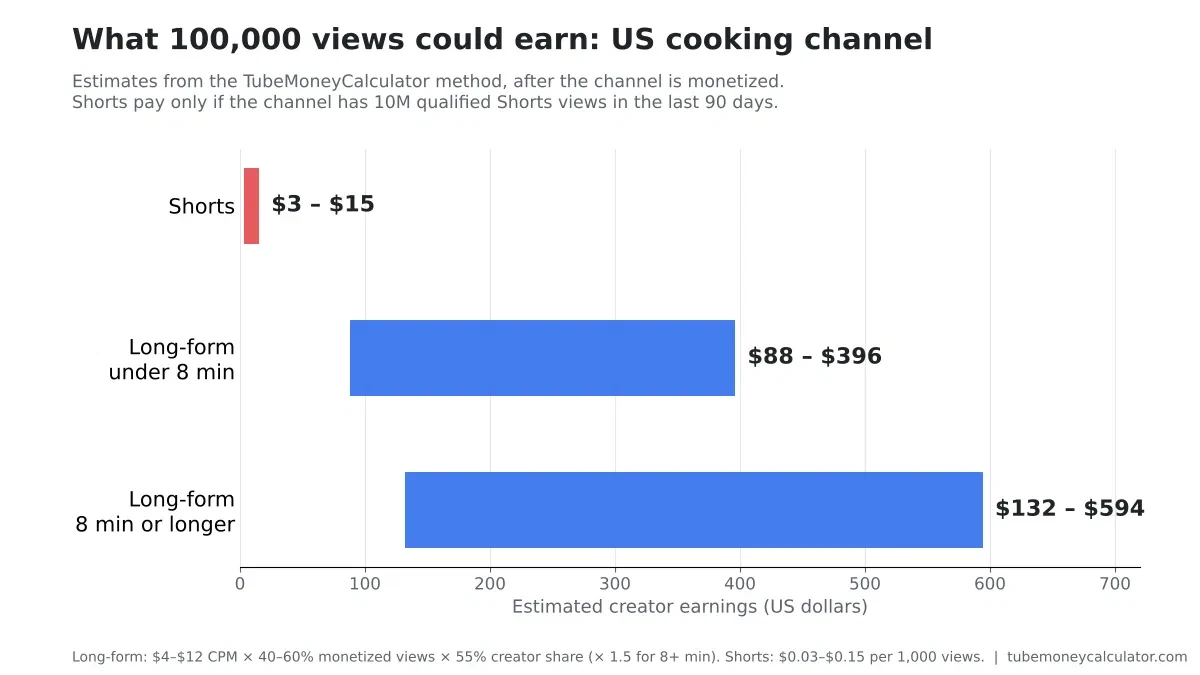
Even after you qualify, the type of video you make changes how much you earn. Here’s what 100,000 views could earn a monetized US cooking channel, using the same method as our YouTube earnings calculator (all numbers come from the methodology page):
Long-form, under 8 minutes:
- Low: $4 CPM × 40% monetized views × 55% creator share = $0.88 per 1,000 views → 100 × $0.88 = $88
- High: $12 CPM × 60% × 55% = $3.96 per 1,000 views → 100 × $3.96 = $396
Long-form, 8 minutes or longer (the calculator applies a 1.5× boost because longer videos can carry mid-roll ads):
- Low: $0.88 × 1.5 = $1.32 → $132
- High: $3.96 × 1.5 = $5.94 → $594
Shorts (the calculator uses $0.03 to $0.15 per 1,000 views for a US audience):
- 100 × $0.03 = $3 up to 100 × $0.15 = $15
Worked example 3: a Canadian gaming channel
Gaming has lower ad rates ($2 to $8 CPM), and the calculator counts a Canadian audience at 0.85× the US rate. For 100,000 views:
| Video type | Math (low → high) | Estimate for 100,000 views |
|---|---|---|
| Shorts | $0.03–$0.15 × 0.85 = $0.026–$0.128 per 1,000 | $2.55 – $12.75 |
| Long-form under 8 min | $2–$8 × 40–60% × 55% × 0.85 | $37.40 – $224.40 |
| Long-form 8+ min | the line above × 1.5 | $56.10 – $336.60 |
One extra 2027 rule for Shorts money: once you’re in the program, you’ll only share in Shorts ad revenue while you have 10 million qualified Shorts views in the last 90 days. Below that, you stay in the program and keep earning from long-form (details in my 10 million Shorts views guide). That’s one more reason a small channel shouldn’t depend on Shorts income.
These are estimates, not promises. Your real numbers depend on your audience, topic, and time of year. You can plug in your own niche and country in the calculator to see your range.
So should you stop making Shorts? No. Use them as a doorway
Shorts are one of the easiest ways for a new channel to get discovered. The trick is to treat them as a doorway that sends people to your long videos, because that’s where the hours (and the bigger money) come from.
YouTube has a built-in feature for exactly this. According to YouTube Help: Add a related video to your Shorts, you can attach one of your own videos to a Short, and viewers see a tappable link just below your channel name.
Worked example 4: how much can a Shorts doorway add?
YouTube doesn’t publish how many viewers tap that link, so this example uses an assumed 1% tap rate. Measure your own rate before you rely on it.
- You post 30 Shorts in a month, averaging 10,000 views each: 300,000 Shorts views.
- 1% tap the related video: 300,000 × 0.01 = 3,000 long-form views.
- They watch 6 minutes on average: 3,000 × 6 = 18,000 minutes.
- Turn minutes into hours: 18,000 ÷ 60 = 300 qualified watch hours.
- Over a year: 300 × 12 = 3,600 hours.
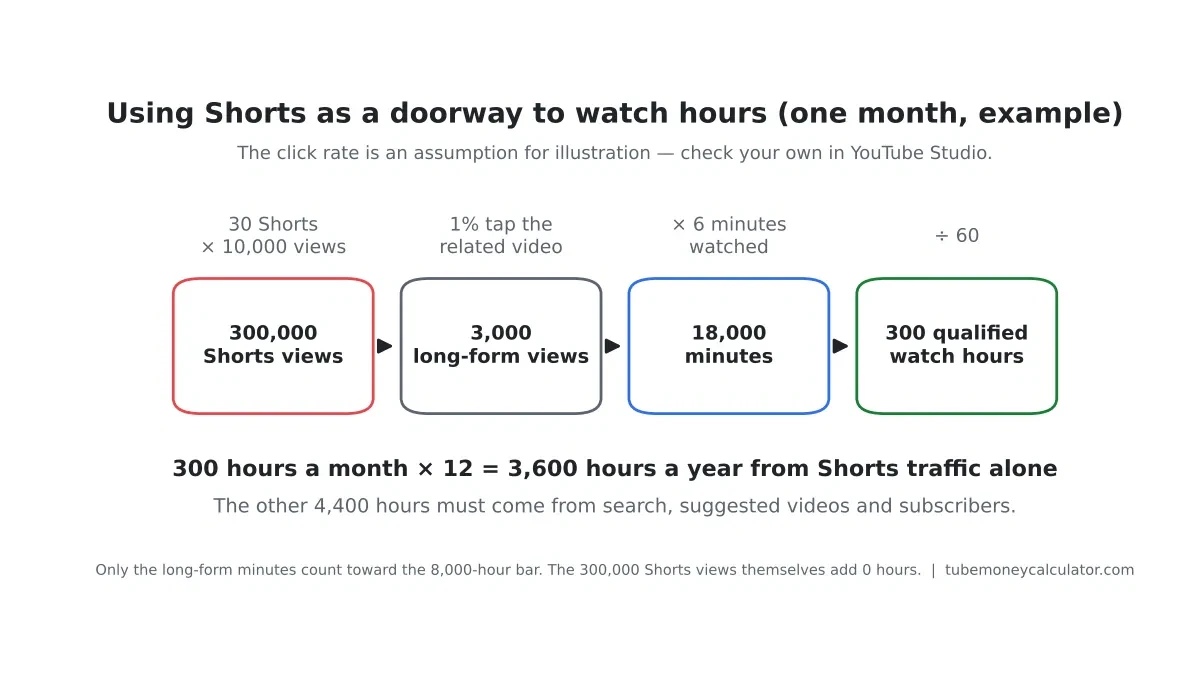
Notice two things. The 300,000 Shorts views added zero hours by themselves; every hour came from the long video. And even in this example, Shorts covered less than half of the 8,000. The rest has to come from search, suggested videos and subscribers, which means the long videos still need to be worth finding on their own.
A step-by-step Shorts-to-long-form plan for a solo creator
- Make the long video first. Pick a topic people search for in your niche and make a long-form video that fully answers it. This is your “destination.”
- Cut 3–5 Shorts from it, or film them alongside. Each Short should deliver one small, complete idea and leave a clear reason to watch the full video (“here’s step 1 — the full recipe is in the linked video”).
- Attach the long video as the related video on every one of those Shorts (YouTube Studio → Content → open the Short → choose a related video → Save). YouTube says this needs advanced feature access.
- Say it out loud, too. A quick spoken or on-screen line pointing to the full video helps more people notice the link.
- Protect your average view duration. Start long videos with the payoff, cut slow intros, and use chapters. Remember: going from 4 to 6 minutes average cuts the views you need from 120,000 a year to 80,000.
- Check what’s working every two weeks. In YouTube Studio, look at where your long-form views come from (the traffic source report) and at your watch hours on the Earn tab. If Shorts aren’t sending viewers, change the hook or the topic match.
- Don’t delete old long videos to “clean up” your channel. Deleted videos take their watch hours with them.
- Stay inside the rules. No bought views, no sub-for-sub, no re-uploading other people’s content. Paid ad views don’t count toward watch hours anyway, and policy strikes can stop monetization entirely.
FAQ
Do Shorts count toward the 4,000 or 8,000 watch hours?
No. Shorts watch time in the Shorts feed doesn’t count toward either number. Only long-form videos (including podcasts) and archived live streams that are public count. Shorts have their own route measured in qualified views.
Can I combine my Shorts views and long-form watch hours to qualify?
No. YouTube treats them as two separate routes. You need to fully meet one of them: 8,000 hours (or 4,000 before February 1, 2027) or 20 million Shorts views (or 10 million before February 1, 2027), plus 1,000 subscribers.
Do views that come from a Short’s related video link count as watch hours?
The minutes people spend watching your long video should count like any other long-form watch time, as long as the long video is public. YouTube’s help page doesn’t spell out how these views are reported, so check your watch hours in Studio after a few weeks.
I’m already in the YouTube Partner Program. Do I need 8,000 hours now?
No. YouTube says the new entry requirement doesn’t affect creators already in the program. But you do need to accept the updated terms in YouTube Studio by January 31, 2027, to keep full access to the affected earnings, and Shorts revenue sharing depends on the 10 million Shorts views rule.
Are Shorts still worth making in 2027?
Yes, for discovery. Shorts can reach people who would never find your long videos. Just don’t count on them for watch hours or as your main income at a small size. Use them to point viewers toward your long-form work.
Your next step
Open YouTube Studio and write down two numbers: your average view duration on long videos and your long-form watch hours in the last 365 days. Then use the formula from this article (hours left × 60 ÷ average minutes) to see how many long-form views you still need. When you’re ready to see what that channel could earn once it qualifies, put your niche, audience country and video length into the free TubeMoneyCalculator Earnings Estimator, and read how the estimate works so you know what the range means.
Rules checked against YouTube’s official pages on October 19, 2026. YouTube may update details before February 1, 2027, so always check the linked official pages for the latest version.