You finally got into the YouTube Partner Program. Your Shorts bring in a few dollars every month, nothing huge, but it’s real money and it’s growing. Then you read that starting February 1, 2027, you need 10 million Shorts views every 90 days to keep earning from Shorts. Your channel gets maybe 2 or 3 million. So is your Shorts money about to vanish? Are you about to get kicked out?
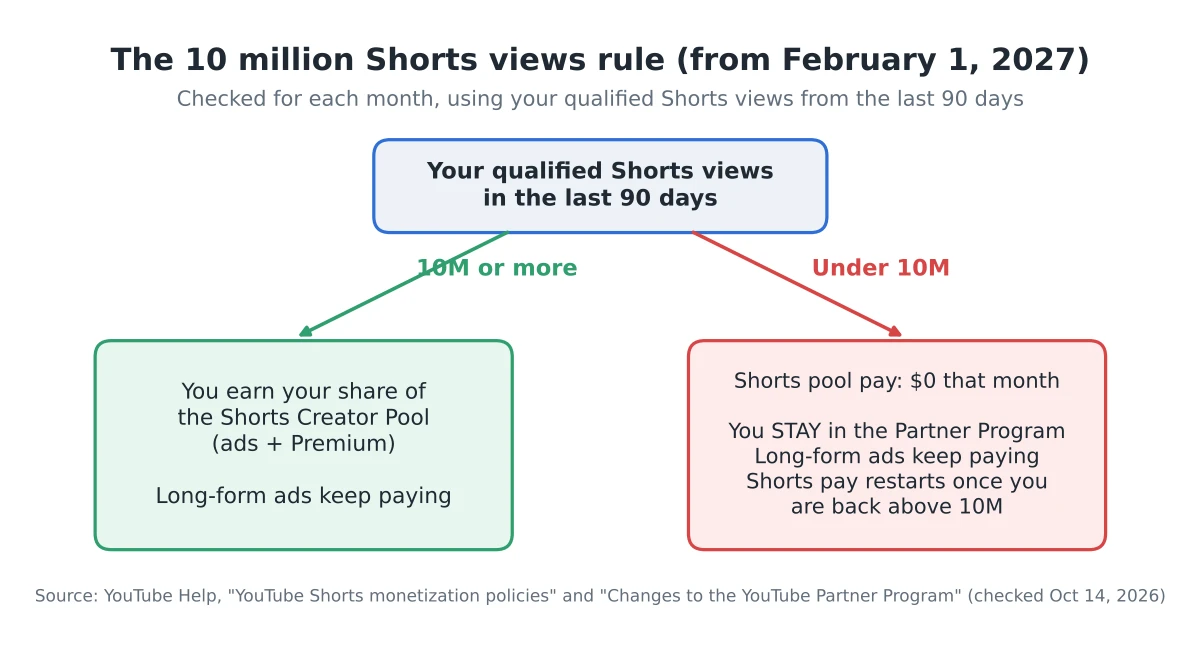
Here’s the short answer. From February 1, 2027, a channel needs at least 10 million qualified Shorts views in the last 90 days to earn Shorts ad and Premium revenue for a given month. If you’re below that, you stay in the Partner Program and keep earning from your long-form videos. Only your Shorts pool money pauses, and it starts again once you’re back above 10 million.
In this guide I’ll explain exactly what the rule says (from YouTube’s own pages), how to check where your channel stands, what’s really at stake in dollars, and how a one-person channel can decide between chasing 10 million Shorts views and moving toward long-form videos.
This is article 3 in our YPP 2027 series. If you’re new to the changes, start with YouTube Partner Program Changes in February 2027.
What the 10 million Shorts views rule actually says
YouTube announced the change in its official post, YouTube Partner Program updates for 2027. The details are on two Help pages: YouTube Shorts monetization policies and Changes to the YouTube Partner Program. Here’s what they say, in plain English (checked on October 14, 2026):
- When: It starts February 1, 2027.
- The bar: At least 10 million qualified Shorts views in the last 90 days.
- It’s checked month by month: YouTube’s Help page says you need that number “to be eligible for Shorts ad and YouTube Premium revenue for each month.” So it isn’t a one-time test. It rolls forward.
- If you’re below it: You lose Shorts pool earnings for that month, but nothing else. YouTube’s Help page puts it simply: “If you miss this threshold, you will not be removed from YPP.” Long-form ad money is not affected.
- Getting it back: YouTube’s announcement says Shorts revenue sharing picks up again once you cross 10 million again.
- Who it applies to: Every Partner Program channel that earns from Shorts, including channels that joined years ago. This is different from the new entry rules, which only affect new applicants.
What counts as a “qualified” Shorts view?
YouTube’s Partner Program overview describes qualified Shorts views as views from Shorts you’ve set to public that appear in the Shorts Feed. Views on private, unlisted or deleted Shorts don’t count, and neither do views from ad campaigns. YouTube also says Shorts revenue is calculated using engaged views, and that fake views and non-original Shorts are not eligible. YouTube has not published a more detailed breakdown, so treat the view count you see in Studio as a ceiling, not a guarantee.
Don’t mix up the two Shorts numbers
There are two different Shorts numbers in the 2027 changes, and a lot of people confuse them:
| Number | Who it’s for | What it unlocks |
|---|---|---|
| 20 million qualified Shorts views in 90 days | New channels applying to the Partner Program after Feb 1, 2027 (plus 1,000 subscribers) | Getting into the program through the Shorts path |
| 10 million qualified Shorts views in 90 days | Every channel already in the program | Earning your share of the Shorts Creator Pool that month |
The other way into the program for new applicants is 8,000 qualified watch hours of long-form video in 365 days. Watch hours from Shorts in the Shorts Feed do not count toward that.
Step 1: Check where your channel stands today
Before you worry, get your real number. This takes two minutes:
- Open YouTube Studio on a computer.
- Click Analytics in the left menu.
- Click the Content tab, then choose Shorts.
- In the top-right corner, change the date range to Last 90 days.
- Write down the Views number. That’s your rough 90-day Shorts total.
- Do this again next month and the month after. You’re looking for a trend, not one number.
This is an estimate because Studio’s normal view count isn’t exactly the same as “qualified” views. If you’re at 9.5 million, you’re on the edge. If you’re at 2 million, you’re clearly below for now.
Step 2: Understand what 10 million in 90 days really means
Ten million sounds like one giant number. It’s easier to plan with if you break it down:
- Per day: 10,000,000 ÷ 90 = about 111,111 Shorts views every day
- Per month: about 3.33 million Shorts views
Now split it by how often you post. If every view came from Shorts posted in that same 90-day window (90 days is about 12.9 weeks), each Short would need this many views on average:
| How often you post | Shorts in 90 days | Average views each Short needs |
|---|---|---|
| 3 a week | about 39 | about 259,000 |
| 5 a week | about 64 | about 156,000 |
| 1 a day | 90 | about 111,000 |
| 2 a day | 180 | about 56,000 |
| 3 a day | 270 | about 37,000 |
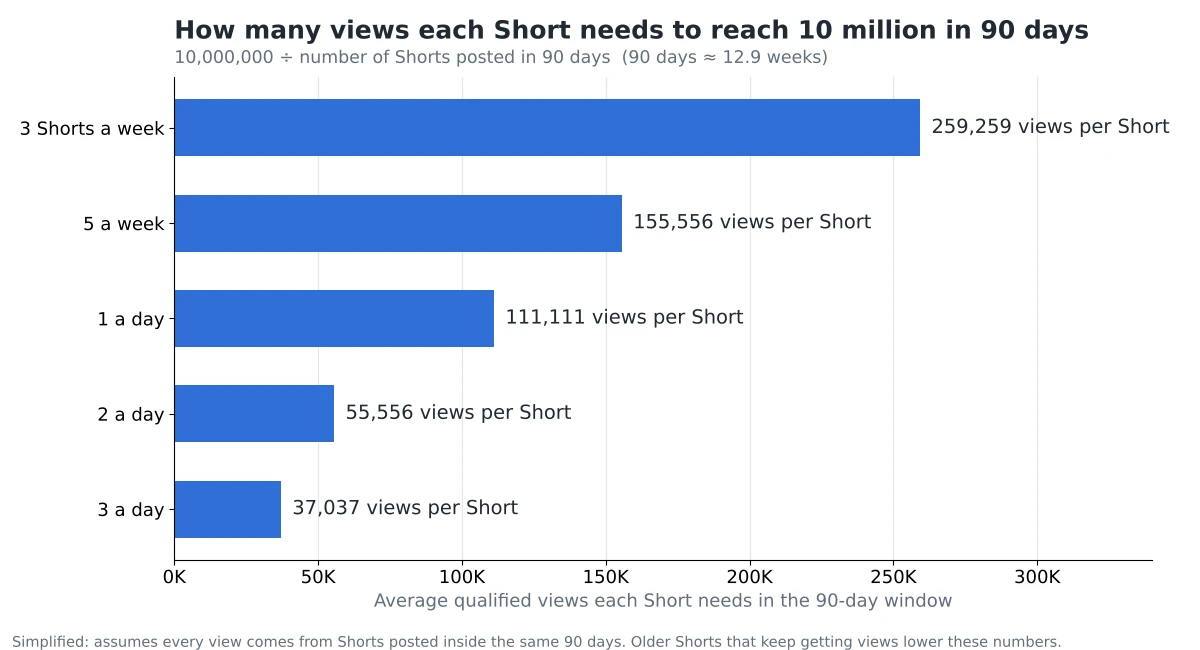
In real life, older Shorts keep picking up views, so your back catalog helps. But this table shows why the rule is hardest on slow, careful creators, like animators or anyone who spends days on each Short.
Step 3: Work out what’s really at stake in dollars
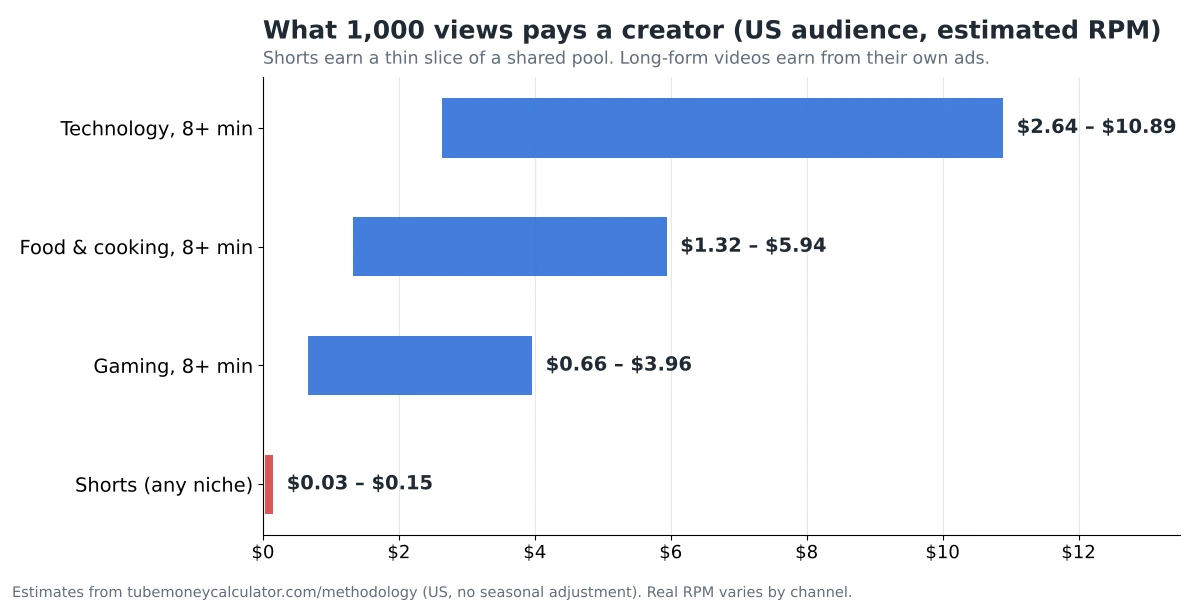
This is the part most articles skip. Shorts pay very little per view, so for many small channels the money that pauses is smaller than the panic suggests.
On our calculator, US Shorts earn an estimated $0.03 to $0.15 per 1,000 views (that’s your RPM, or revenue per 1,000 views, after YouTube’s share). Long-form videos earn far more, because each video earns from its own ads. You can see the full rate tables on our methodology page, and if RPM is new to you, read YouTube RPM Explained.
Worked example 1: A US cooking Shorts channel with 1.2 million views a month
- 90-day total: 1.2 million × 3 = 3.6 million, well below 10 million.
- Estimated Shorts earnings today: 1,200 (thousands of views) × $0.03 to $0.15 = $36 to $180 a month.
- After February 1, 2027: if it stays at this level, that $36 to $180 becomes $0 from the Shorts pool.
- To get to 10 million in 90 days, the channel would need nearly 3 times its current Shorts views.
Now the other option. A US food & cooking video that’s 8 minutes or longer earns an estimated $1.32 to $5.94 per 1,000 views. To replace the lost Shorts money:
- Low end: $36 ÷ $1.32 × 1,000 = about 27,300 long-form views a month
- High end: $180 ÷ $5.94 × 1,000 = about 30,300 long-form views a month
So about 27,000 to 30,000 long-form views a month would replace the Shorts money. With videos under 8 minutes (no mid-roll boost, RPM $0.88 to $3.96), it’s about 41,000 to 45,000 views. For this channel, adding long-form videos is a much more realistic path than tripling its Shorts views.
Worked example 2: A Canadian gaming Shorts channel with 2.5 million views a month
- 90-day total: 2.5 million × 3 = 7.5 million. Close, but below.
- Estimated Shorts RPM for a Canadian audience: $0.03 to $0.15 × 0.85 = $0.0255 to $0.1275.
- Estimated Shorts earnings today: 2,500 × $0.0255 to $0.1275 = $63.75 to $318.75 a month.
- Gap to 10 million: 2.5 million more every 90 days, or about 833,000 more views a month (a 33% increase).
The long-form route is harder here. Gaming is one of the lowest-paying niches. An 8+ minute gaming video with a Canadian audience earns an estimated $0.66 to $3.96 × 0.85 = $0.56 to $3.37 per 1,000 views. Replacing the Shorts money would take:
- $63.75 ÷ $0.561 × 1,000 = about 113,600 long-form views a month
- $318.75 ÷ $3.366 × 1,000 = about 94,700 long-form views a month
For this channel, a 33% push in Shorts views may be the more realistic goal, while slowly building long-form on the side.
The lesson: there’s no single right answer. It depends on how close you are to 10 million and how well your niche pays on long-form. Run your own numbers in the TubeMoneyCalculator: pick your niche and country, choose “Shorts,” then do the same with “8+ min,” and compare.
Step 4: Choose your path (a plan for one-person channels)
Based on your Step 1 number, pick one of these three paths.
Path A: You’re at 7 to 10 million. Push to stay above the line
- Look at your top 10 Shorts from the last 90 days in Analytics. Note the topic, the first 2 seconds, and the length.
- Make more Shorts in the 2 or 3 formats that clearly worked. Don’t spread yourself across new ideas right now.
- Post on a steady schedule you can actually keep for 13 weeks. A pace you drop after three weeks hurts more than it helps.
- Check your 90-day total on the first of every month. If you dip below, don’t panic. The pool money comes back once you’re over again.
Path B: You’re well below (under about 5 million). Start moving toward long-form
- Find the questions your Shorts viewers ask in the comments. Each one can become a longer video.
- Make one long-form video a week, ideally 8 minutes or longer if the topic really needs that time. Don’t pad it. Viewers leave, and that hurts more than a shorter video would.
- Keep posting some Shorts, but use them as trailers: point viewers to the full video. Shorts still bring in subscribers even when they don’t pay.
- Track long-form views monthly and compare against the “replacement” number you worked out in Step 3.
Path C: You’re not in the Partner Program yet
After February 1, 2027, you’ll need 1,000 subscribers plus either 20 million Shorts views in 90 days or 8,000 long-form watch hours in a year. For most small Shorts channels, the watch-hours path is the realistic one. If you’re already close under today’s rules, read Should You Apply for YouTube Monetization Before February 1, 2027?
What not to do: don’t buy views, join “view exchange” groups, or re-upload other people’s clips to hit the number. Fake views and non-original Shorts don’t count toward Shorts revenue anyway, and they can put your whole channel at risk.
Ways to earn from Shorts if you’re below 10 million
Losing the pool share doesn’t mean Shorts are worthless. According to YouTube’s official pages:
- Long-form ad revenue keeps paying. The rule doesn’t touch it.
- Fan funding and shopping: YouTube says the entry requirements for these are not changing. Shorts can still send viewers to memberships or products.
- Targeted Shorts ads: YouTube’s Shorts Help page says that from February 1, 2027, Shorts ads targeted to small groups of 5 or fewer channels will be eligible to earn direct revenue. YouTube hasn’t said how common these ads will be.
- New incentives: YouTube mentioned milestone programs such as YouTube Shopping bonuses, brand-deal incentives and earnings boosts for starting trends. The details have not been announced yet, so don’t plan around them.
- Brand deals: these are between you and the brand, not YouTube, so the 10 million rule doesn’t apply to them.
FAQ
Will I be removed from the YouTube Partner Program if I get under 10 million Shorts views?
No. YouTube says you stay in the program. You just don’t earn from the Shorts Creator Pool for any month in which you’re below the 90-day threshold.
Do my long-form earnings change if my Shorts are below 10 million?
No. YouTube says the rule doesn’t affect other Partner Program earnings, including long-form videos.
Does the 10 million rule apply to channels that joined before 2027?
Yes. The higher entry rules (8,000 hours or 20 million Shorts views) only apply to new applicants. The 10 million Shorts rule applies to every partner channel that wants to earn from Shorts, old or new.
Is it 10 million views per video?
No. It’s your channel’s total qualified Shorts views across all your public Shorts in the last 90 days.
Do I need to do anything before February 1, 2027?
Yes. YouTube asks creators to accept the updated terms in YouTube Studio by January 31, 2027. YouTube says if you don’t, you’ll stop earning from the affected features, though you remain in the program. Watch for the notice in Studio.
Your next step
Open YouTube Studio today and write down your Shorts views for the last 90 days. Then put your monthly Shorts views into the TubeMoneyCalculator with “Shorts” selected, and run it again as an 8+ minute video in your niche. Those two numbers will tell you how much money is really at stake and which path makes sense for your channel.
Remember, these are estimates, not promises. Your real RPM depends on your audience, your niche and the time of year. But knowing your numbers beats guessing, and it gives you over three months to adjust before the rule starts.