Short answer: Yes. When a YouTube Premium or Premium Lite member watches your videos, you get a share of their monthly fee instead of ad money. But only channels in the full YouTube Partner Program can earn it, and from February 1, 2027, Shorts only earn it if the channel has 10 million qualified Shorts views in the last 90 days. For most small channels it is a small extra on top of ad revenue, not a separate paycheck.
Here’s the worry I see from small creators all the time. You look at your analytics and notice a slice of your viewers are Premium members. They never see an ad. So does that mean those views are worth nothing to you? And now YouTube says it’s expanding Premium Lite to every country where Premium is sold. Is that good news or bad news for a one-person channel?
Let’s go through it slowly, with real numbers.
How Premium money actually reaches creators
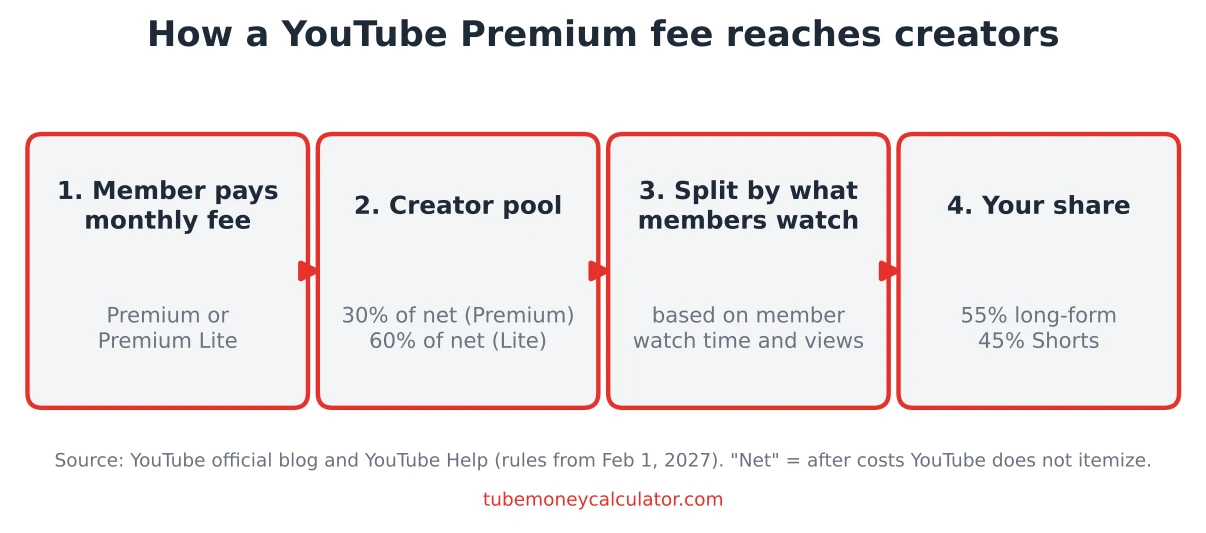
YouTube explains the system on its official blog announcement and on the YouTube Help page Changes to the YouTube Partner Program. In plain English, it works in four steps:
- A viewer pays a monthly fee for YouTube Premium or Premium Lite.
- YouTube puts part of that fee into a creator pool. It is 30% of the net subscription revenue for Premium and 60% for Premium Lite. YouTube says the rest covers the cost of running and promoting the service, including payments to music partners. (“Net” means after costs YouTube doesn’t list one by one, so you can’t see the exact starting amount.)
- The pool is split by what members watch. YouTube shares it based on member watch time and views. The more Premium members watch your videos, the bigger your slice.
- You keep your revenue share: 55% for long-form videos and 45% for Shorts. Those are the same splits as ad revenue.
Why is the Premium Lite pool so much bigger in percent (60% vs 30%)? Premium includes YouTube Music, and music partners need to be paid out of that fee. Premium Lite is the cheaper plan. YouTube says it gives “uninterrupted, offline, and background viewing of most content,” but it’s built for regular videos, not music. So more of each Lite dollar can go to video creators.
One more thing worth knowing: YouTube says that “on average, creators earn more per user from Premium than from ads (based on 2026 performance).” That’s an average across all creators. It’s not a promise for your channel, and YouTube doesn’t give a per-view figure. Still, it answers the big fear: a Premium viewer is not a wasted viewer.
What changes on February 1, 2027
Premium revenue is part of the bigger Partner Program update that we covered earlier in this series. Here are the parts that touch Premium money, checked against YouTube’s Help page on October 17, 2026:
- Premium Lite is expanding to every country where YouTube Premium is offered. YouTube hasn’t announced a date for each country yet.
- New pool percentages: 30% (Premium) and 60% (Premium Lite) of net subscription revenue.
- Shorts need 10 million qualified views in 90 days to earn from ads and subscription revenue on Shorts. Below that, your Shorts stop earning Premium money for that period. But you stay in the program and your long-form videos keep earning. We explained this in detail in the 10 million Shorts views rule.
- New applicants need more to unlock ad and Premium revenue: 1,000 subscribers plus either 8,000 qualified watch hours in the last 365 days or 20 million qualified Shorts views in the last 90 days. Channels already in the program are not affected.
- Accept the new terms by January 31, 2027. YouTube says that to keep fully monetizing, you need to review and accept the updated terms in YouTube Studio by that date.
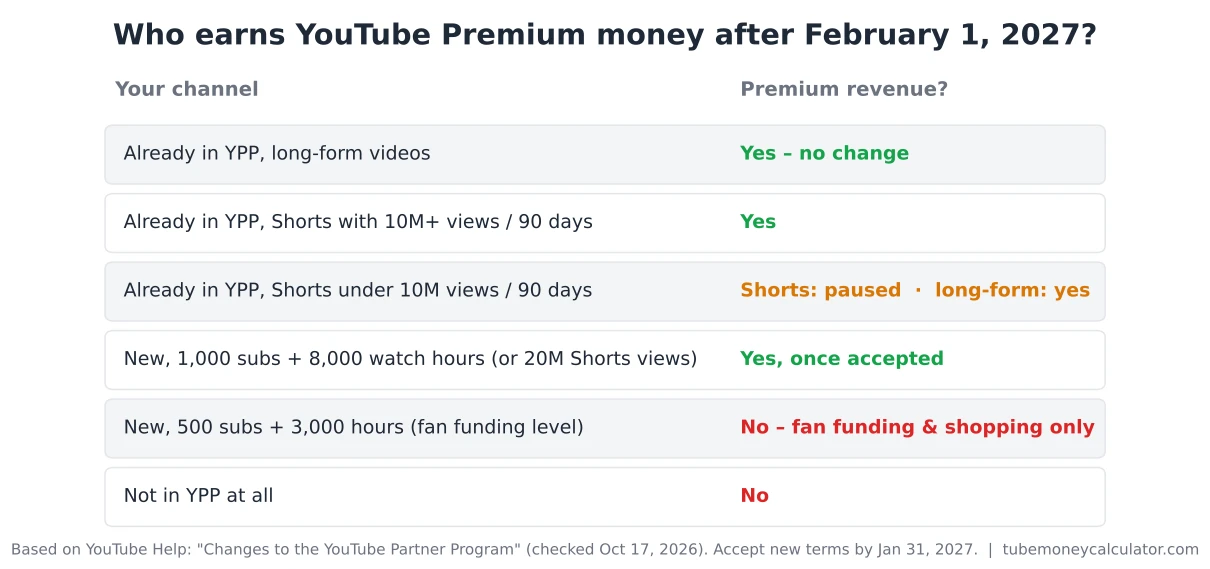
| Your channel | Earns Premium money after Feb 1, 2027? |
|---|---|
| Already in YPP, long-form videos | Yes, no change |
| Already in YPP, Shorts with 10M+ qualified views in 90 days | Yes |
| Already in YPP, Shorts under 10M views in 90 days | Shorts: paused until you cross 10M again. Long-form: yes |
| New, 1,000 subs + 8,000 watch hours (or 20M Shorts views) | Yes, once accepted into ads and Premium revenue sharing |
| New, 500 subs + 3,000 hours (fan funding level) | No. Fan funding and shopping only |
| Not in YPP | No |
That fifth row surprises a lot of people. The lower 500-subscriber level gives you fan funding, YouTube Shopping and creator partnerships. It doesn’t give you ad money or Premium money. Premium revenue comes with the ads level. YouTube’s How to earn money on YouTube page says it requires accepting the relevant contract modules.
Worked example 1: What one member could be worth to you
YouTube doesn’t publish an exact per-member formula, so treat this only as an illustration of how the pieces fit together. I’ll use the US monthly prices reported in April 2026 ($15.99 for Premium and $8.99 for Premium Lite). Because the real “net” amount is lower than the sticker price, the true numbers will be lower than these.
Say one US member spends 10% of their viewing time on your channel.
Premium member ($15.99):
- Pool: $15.99 × 30% = $4.80
- Your slice of their viewing: $4.80 × 10% = $0.48
- Your share (long-form): $0.48 × 55% = about $0.26 a month
- If those were Shorts: $0.48 × 45% = about $0.22 a month
Premium Lite member ($8.99):
- Pool: $8.99 × 60% = $5.39
- Your slice: $5.39 × 10% = $0.54
- Your share (long-form): $0.54 × 55% = about $0.30 a month
- If those were Shorts: $0.54 × 45% = about $0.24 a month
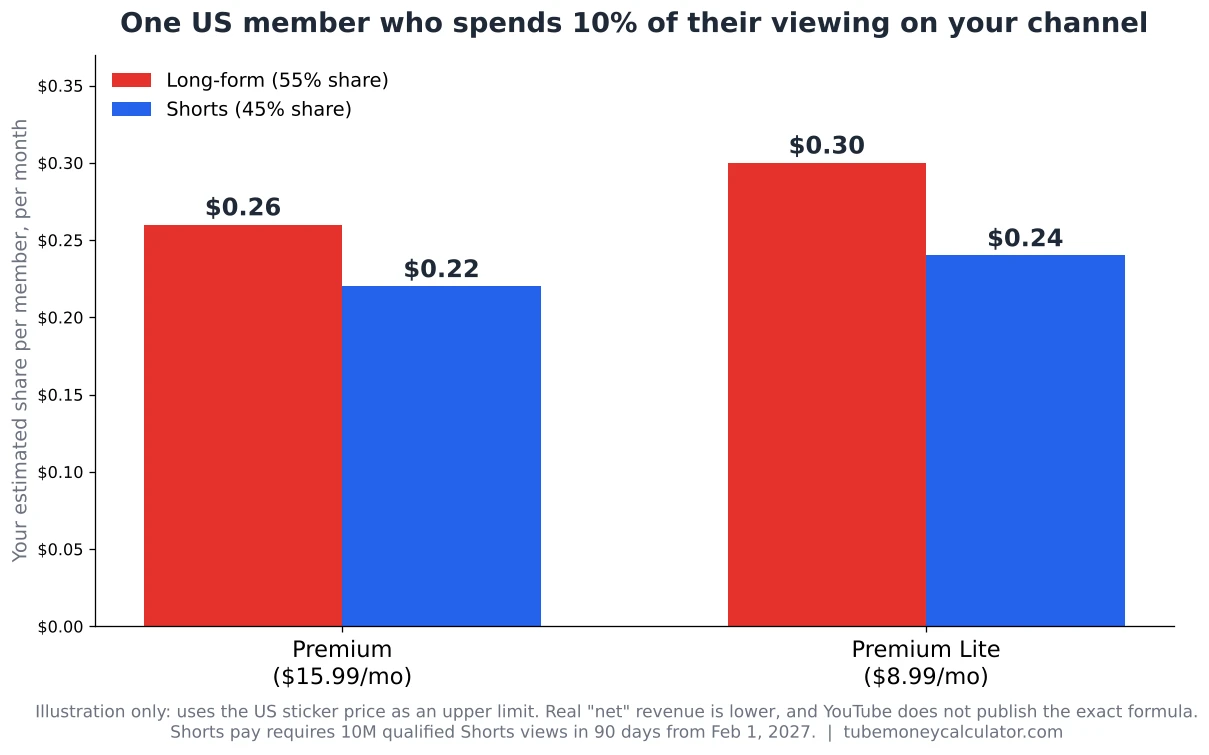
Two lessons hide in these numbers.
First, Premium Lite is not bad news for creators. Even though the plan is cheaper, the bigger 60% pool means a Lite member can be worth about the same to you as a full Premium member, and sometimes a bit more.
Second, 10% of someone’s viewing is a lot. That’s a true fan. Most viewers spend a tiny fraction of their month on any one channel. So for a small channel, Premium money comes from many members each watching a little, which is exactly why it ends up small.
Worked example 2: Why your real RPM can beat a calculator
This is where Premium affects your earnings estimates.
YouTube’s Help page on ad revenue analytics says your RPM (revenue per 1,000 views) includes several sources, “including: ads, channel memberships, YouTube Premium revenue.” So the RPM in YouTube Studio already has Premium money mixed in.
Our calculator’s methodology is open about the opposite: it does not model Premium revenue. It estimates ad revenue only. It assumes 40% to 60% of views show ads, then applies the 55% creator share. So the calculator gives you a fair “ads only” floor, and your real Studio RPM can land a little higher because of Premium and memberships.
US tech channel, 100,000 long-form views a month, 10-minute videos:
- Technology CPM in the model: $8 to $22. US multiplier: 1.00. Mid-roll boost for 8+ minutes: 1.5×.
- Low RPM: $8 × 1.00 × 40% × 55% × 1.5 = $2.64
- High RPM: $22 × 1.00 × 60% × 55% × 1.5 = $10.89
- Ad estimate: 100,000 ÷ 1,000 × $2.64 to $10.89 = $264 to $1,089 a month
Canada cooking channel, 50,000 long-form views a month, 6-minute videos:
- Food & cooking CPM: $4 to $12. Canada multiplier: 0.85. No mid-roll boost under 8 minutes.
- Low RPM: $4 × 0.85 × 40% × 55% = $0.75
- High RPM: $12 × 0.85 × 60% × 55% = $3.37
- Ad estimate: 50 × $0.748 to $3.366 = $37.40 to $168.30 a month
If your Studio RPM is above these ranges, Premium viewers are one honest reason. Our “Know your real RPM” check on the calculator home page lets you type in your actual RPM so the estimate matches your channel.
How to see your Premium earnings in YouTube Studio
There’s no separate “Premium” card, which confuses many creators. Here’s where to look:
- Sign in to YouTube Studio.
- Click Analytics in the left menu.
- Click the Revenue tab at the top. (You only see it if you’re in the Partner Program.)
- Find the card called “How you make money.”
- Look at Watch Page ads and Shorts Feed ads. According to YouTube’s Check your YouTube revenue page, Premium revenue is counted inside these two lines. The Shorts Feed line is defined as revenue “from Shorts Feed ads and YouTube Premium.”
Revenue can take about two days to show up. YouTube’s Premium help page also says you can see watch time and views from Premium members in Analytics, and Premium money is paid on the same monthly schedule as ad revenue.
What a solo creator can actually do about it
You can’t control who buys Premium. You can control whether the people who have it spend time on your videos. Here’s an honest plan:
- Accept the new terms before January 31, 2027. Open Studio, find the terms notice on the dashboard or the Earn tab, and review each module. Skipping this doesn’t remove you from the program, but you lose earnings from the features tied to the modules you don’t accept until you sign.
- If you’re not in YPP yet, aim for the ads level, not just the 500-sub level. Premium money only starts at the full level, which needs 8,000 hours from February 1. Our guide on how long 8,000 watch hours takes shows the math.
- Make long-form videos people actually finish. The pool is split by watch time. A 10-minute video watched to the end does more for you than three videos people leave after 30 seconds.
- Make videos that still work in the background or offline. Premium and Premium Lite members can download videos and play them with the screen off. YouTube says that watch time counts too. Step-by-step tutorials, explainers, talk-style videos and calm “watch while you cook” content suit this well. They still have to be your own original work. Re-uploaded or reused content can break YouTube’s monetization rules.
- Build series and playlists. One good video that leads into the next keeps members watching your channel instead of someone else’s.
- Don’t rely on it. For most small channels, Premium is a small extra. Fan funding, a few honest brand deals and good long-form videos matter more. Our post on making money before 8,000 watch hours covers those.
Not announced yet: YouTube hasn’t given amounts or rules for its new Shopping bonuses, brand-deal production credits or trend boosts. It says eligible creators will be notified to opt in. I’ll update this series when the details are official.
FAQ
Do YouTubers get paid when I watch with YouTube Premium?
Yes, if the channel is in the YouTube Partner Program with the right modules accepted. Part of your fee goes into a pool that’s shared based on what you watch. From February 1, 2027, Shorts only earn this if the channel has 10 million qualified Shorts views in the last 90 days.
Does Premium Lite pay creators less than full Premium?
Not necessarily. Lite costs less, but 60% of its net revenue goes to the creator pool, compared with 30% for Premium. In our illustration above, a Lite member was worth about the same as a full Premium member.
Is a Premium view worth more than an ad view?
YouTube says creators earn more per user from Premium than from ads on average, based on 2026. It doesn’t give a per-view number, and results vary by channel. Don’t plan around a fixed figure.
Can I earn Premium money with 500 subscribers?
No. The 500-subscriber level unlocks fan funding, shopping and creator partnerships. Premium revenue comes with the ads level. From February 1, 2027, new channels need 1,000 subscribers plus 8,000 qualified watch hours in 365 days (or 20 million qualified Shorts views in 90 days).
Why doesn’t the TubeMoneyCalculator include Premium?
Because no one outside YouTube knows how many of your viewers are Premium members or how the pool splits for your channel. Rather than guess, we show an ads-only estimate and explain this on our methodology page. Your own Studio RPM tells the full story.
Your next step
Open YouTube Studio today, go to Analytics → Revenue, and write down your real RPM for the last 28 days. Then enter it in the “Know your real RPM” box on the TubeMoneyCalculator. You’ll see how your actual earnings, Premium included, compare with the ads-only estimate. And while you’re in Studio, check whether the new Partner Program terms are waiting for you. January 31 will come faster than you think.
All rules in this article were checked against official YouTube pages on October 17, 2026. YouTube may update them before February 2027, so check the linked pages before you make big decisions. Earnings figures are estimates, not promises.