You type this question into Google and get five different answers. One site says $1,000. Another says $5,000. A third says $20,000. Or it happened to you: a video finally passed a million views, you opened YouTube Studio, and the number was far smaller than you had pictured.
That gap is one of the most common frustrations creators talk about. A million sounds like it should change your life. Often it pays for a used laptop.
The short answer: For a US audience, 1 million views on regular (long) videos pays roughly $440 to $22,000 in ad revenue, depending mostly on your niche and video length. Everyday niches like food, vlogs and entertainment land around $660 to $5,900. One million views on Shorts pays far less, about $30 to $150.
Those are estimates from the model behind our YouTube earnings calculator, not promises. The rest of this article shows where the numbers come from, so you can work out your own.
Why nobody can give you one number
YouTube doesn’t pay you for views. Advertisers pay YouTube to show ads, and YouTube shares that money with you. A view with no ad on it earns you nothing from ads.
Three facts from YouTube’s own help pages explain most of the gap:
- You keep 55% of the ad money on long videos. YouTube keeps the other 45%. This is written in the YouTube partner earnings overview.
- Not every view shows an ad. Some viewers use ad blockers. Some videos get limited ads. Sometimes there’s simply no ad to show. YouTube’s ad revenue analytics page explains that RPM, your earnings per 1,000 views, counts all your views, including the ones that weren’t monetised.
- Videos of 8 minutes or longer can carry mid-roll ads. Those are ads in the middle of the video, on top of the one at the start. YouTube explains this on its mid-roll ad breaks page.
On top of that, advertisers pay very different prices depending on the topic of the video and the country of the viewer. A bank will pay much more to reach someone watching a video about retirement accounts than a game studio will pay to reach someone watching a speedrun.
The formula we use
Our calculator puts those pieces together like this:
Earnings = (views ÷ 1,000) × RPM
RPM = niche CPM × country multiplier × share of views with an ad × 55% × mid-roll boost
CPM is what advertisers pay per 1,000 ad views. The model assumes 40% to 60% of views show an ad, which is what creates the low and high ends of each range. The mid-roll boost is 1.5 for videos of 8 minutes or longer, and 1 (no boost) for shorter ones. Every number is listed on our methodology page, so you can check the maths yourself.
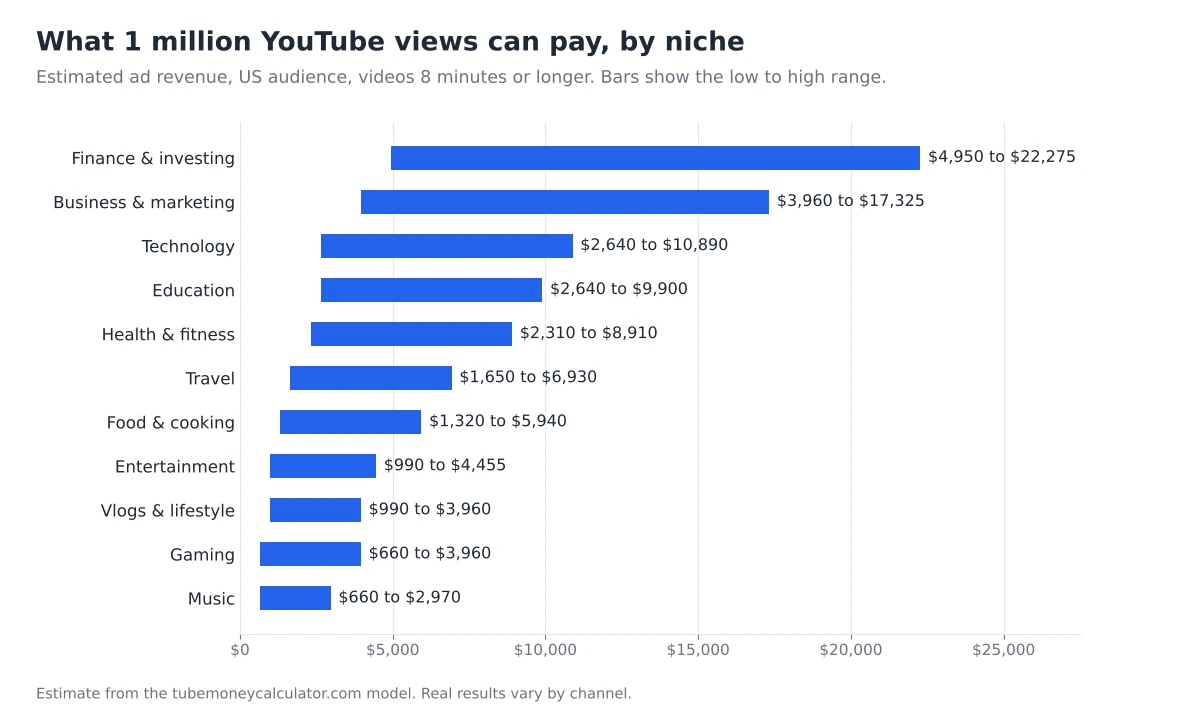
What 1 million views pays, by niche
This table shows estimated ad revenue for 1 million views from a US audience. Find your niche, then pick the column that matches your usual video length.
| Niche | Videos under 8 minutes | Videos 8 minutes or longer |
|---|---|---|
| Finance & investing | $3,300 to $14,850 | $4,950 to $22,275 |
| Business & marketing | $2,640 to $11,550 | $3,960 to $17,325 |
| Technology | $1,760 to $7,260 | $2,640 to $10,890 |
| Education | $1,760 to $6,600 | $2,640 to $9,900 |
| Health & fitness | $1,540 to $5,940 | $2,310 to $8,910 |
| Travel | $1,100 to $4,620 | $1,650 to $6,930 |
| Food & cooking | $880 to $3,960 | $1,320 to $5,940 |
| Entertainment | $660 to $2,970 | $990 to $4,455 |
| Vlogs & lifestyle | $660 to $2,640 | $990 to $3,960 |
| Gaming | $440 to $2,640 | $660 to $3,960 |
| Music | $440 to $1,980 | $660 to $2,970 |
The ranges are wide on purpose. A narrow number would look more confident, but it would be wrong more often. Your real result depends on things no outside tool can see, like how many of your viewers actually got an ad.
Worked example 1: a US gaming channel
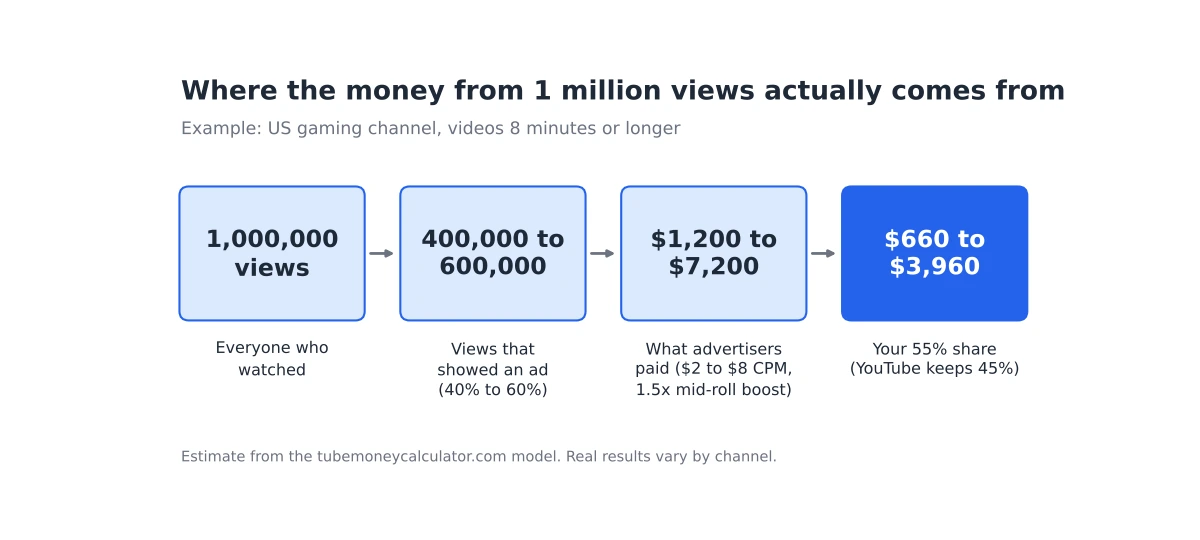
Say you run a gaming channel. Your viewers are mostly in the US, and your videos run about 12 minutes. This month your videos got 1 million views.
The model uses a gaming CPM of $2 to $8.
- Low end: $2 × 1.00 (US) × 40% × 55% × 1.5 = $0.66 RPM. Then 1,000,000 ÷ 1,000 × $0.66 = $660.
- High end: $8 × 1.00 (US) × 60% × 55% × 1.5 = $3.96 RPM. Then 1,000 × $3.96 = $3,960.
So a million gaming views is roughly $660 to $3,960. That’s real money, but it isn’t the “quit your job” number many people expect.
Worked example 2: a Canadian tech channel
Now say you review laptops and phones, your viewers are mostly in Canada, and your videos are also over 8 minutes. Same 1 million views.
The model uses a technology CPM of $8 to $22, and a Canada multiplier of 0.85. That means it assumes Canadian views earn about 85% of what US views earn.
- Low end: $8 × 0.85 × 40% × 55% × 1.5 = $2.244 RPM. Then 1,000 × $2.244 = $2,244.
- High end: $22 × 0.85 × 60% × 55% × 1.5 = $9.2565 RPM. Then 1,000 × $9.2565 = about $9,257.
Same view count as the gaming channel. More than double the money. The only things that changed were the topic and the country.
What about 100,000 views?
Most channels reach 100,000 views long before a million, so this is the more useful number for many readers. The maths is the same. Just divide the table above by 10.
| Niche (US, 100,000 views) | Videos under 8 minutes | Videos 8 minutes or longer |
|---|---|---|
| Finance & investing | $330 to $1,485 | $495 to $2,228 |
| Technology | $176 to $726 | $264 to $1,089 |
| Food & cooking | $88 to $396 | $132 to $594 |
| Gaming | $44 to $264 | $66 to $396 |
If you post short cooking videos and get 100,000 views in a month, expect something like $88 to $396. It’s a nice side income, not a salary.
Why 1 million Shorts views pays so little
Shorts are paid in a completely different way. There’s no ad attached to your Short. Ads play between Shorts in the feed, and YouTube adds all of that money together each month into one big pool. Part of the pool covers music licensing. The rest is split among creators by their share of Shorts views, and each creator keeps 45% of their slice. YouTube explains the steps on its Shorts monetization page.
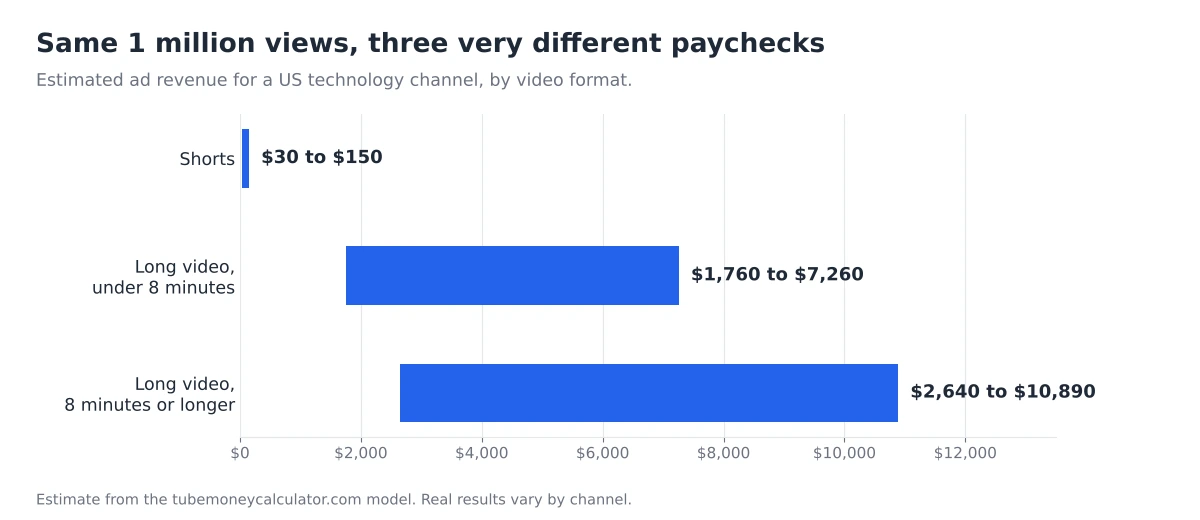
The result is a much lower rate. Our model uses $0.03 to $0.15 per 1,000 Shorts views for a US audience. For 1 million views:
- Low end: 1,000 × $0.03 = $30
- High end: 1,000 × $0.15 = $150
Niche doesn’t change this number in the model, because the money comes from a shared pool and not from ads matched to your topic. One honest note: Shorts rates are the least certain numbers we publish, so treat this range as a rough guide.
Two more things that move the number
The month. Advertisers spend more before the holidays and less right after. With the seasonal option turned on, the model multiplies earnings by 0.75 in January and 1.35 in December. Take a US tech channel with 1 million views on 8+ minute videos:
- January: $2,640 to $10,890 × 0.75 = $1,980 to $8,168
- December: $2,640 to $10,890 × 1.35 = $3,564 to $14,702
Same channel, same views, and December pays almost double January.
Where your viewers live. A viral video often travels outside the US and Canada. The model treats a mixed worldwide audience as earning about 45% of a US one. So if your million views came from all over the world, cut the US table roughly in half before you compare it with your Studio number.
How to work out your own number
If your channel already earns money, your own data beats any calculator:
- Open YouTube Studio and click Analytics, then the Revenue tab.
- Set the date range to the last 28 or 90 days.
- Find your RPM. This is what you actually earned per 1,000 views, after YouTube’s cut.
- Multiply it by 1,000. That’s what a million views would pay at your current rate.
For example, if your RPM is $3.20, a million views is about 1,000 × $3.20 = $3,200. If RPM is new to you, our guide to RPM and CPM explains it in plain words.
If you’re not monetised yet, use the calculator to get a realistic range:
- Open the Views to Money tool on our home page.
- Type in 1,000,000 views (or 100,000, or whatever you want to test).
- Choose your niche and the country most of your viewers are in.
- Choose your video length: Shorts, under 8 minutes, or 8+ minutes.
- Read the low and high numbers together. Plan around the low one.
What a view count doesn’t tell you
- Lifetime views are not monthly income. A video with 1 million views earned that money across its whole life, maybe over several years. A channel that gets 1 million views every month is in a very different position.
- You must be in the YouTube Partner Program to earn ad money. That currently takes 1,000 subscribers plus either 4,000 watch hours in the last 12 months or 10 million Shorts views in the last 90 days, according to YouTube’s eligibility page. We cover this in how many views you need to make money.
- Ad revenue is only one income stream. Sponsorships, channel memberships and affiliate links are separate. None of them are in these estimates.
- It’s income before taxes. What lands in your bank account still has to be reported.
Frequently asked questions
Does YouTube pay $1 for every 1,000 views?
No. There’s no fixed rate. In our model, a US channel with long videos earns anywhere from $0.44 to $22.28 per 1,000 views depending on niche and length. A dollar per thousand is close to the low end for gaming or music, and far too low for finance.
How much is 1 million views on YouTube Shorts?
Roughly $30 to $150 for a US audience in our model. Shorts are paid from a shared monthly pool, and creators keep 45% of their share, so the rate per view is much lower than for long videos.
Do I get paid for 1 million views if I’m not monetised?
No. You only earn a share of ad revenue once your channel is accepted into the YouTube Partner Program and you’ve turned on monetisation.
Do Canadian views pay the same as US views?
Close, but a little less. Our model assumes views from Canada earn about 85% of what US views earn. A US food channel’s $880 to $3,960 becomes about $748 to $3,366 with a Canadian audience.
Why is my real number lower than every estimate online?
Usually one of three reasons: many of your views were Shorts, many of your viewers were outside the US and Canada, or fewer of your views showed an ad than the tool assumed. Compare your Studio RPM with the range for your niche to see which one applies.
Your next step
Pick the one video format you post most, then run your own numbers in the YouTube earnings calculator with 100,000 views and with 1,000,000 views. Write down the low end of each. That gives you an honest target to plan around, and it takes about a minute.
If you want to see how each input changes the result, how the calculator works walks through it step by step.
All figures in this article are estimates based on the assumptions on our methodology page. They are not a promise of earnings.